If your baby is approaching the age for starting solids, a pediatric visit is a useful time to ask more than, “Can we start?”
Ask whether your baby is developmentally ready, which iron-rich foods to prioritize, how and when to introduce peanut and other allergens, which textures are appropriate, how to reduce choking risk, whether baby-led weaning is suitable, how solids should fit around breast milk or formula, and whether your baby’s medical history changes any general recommendation.
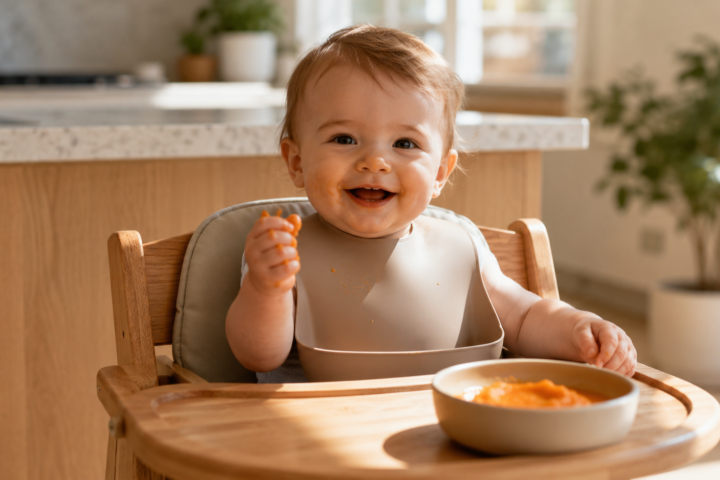
The American Academy of Pediatrics and current CDC guidance recommend introducing complementary foods at about 6 months, while recognizing that developmental readiness varies. Introducing solid foods before 4 months is not recommended. Signs of readiness include adequate head and neck control, sitting with support, opening the mouth for food, bringing objects to the mouth, and being able to swallow food rather than consistently pushing it back out.
The best pediatric visit is therefore not simply about receiving permission to start. It is about leaving with a feeding plan that makes sense for your particular baby.
Starting Solids Is a Developmental Decision, Not Just a Birthday
Many parents circle a date on the calendar and assume that starting solids begins automatically when their baby turns 6 months old.
Age matters, but it is only part of the decision.
Current CDC guidance says complementary foods can generally begin at about 6 months, and it lists developmental abilities that help show a baby is ready. The AAP similarly emphasizes that readiness varies from child to child.
That is why the pediatric appointment before starting solids is useful.
Instead of asking only, “Is 6 months the right age?” bring questions that help your pediatrician assess your baby’s feeding skills, growth, medical history, allergy risk, and nutritional needs.
The following questions give you a practical starting point.
1. “Does My Baby Look Developmentally Ready for Starting Solids?”
This should usually be the first question.
Ask your pediatrician to look at the whole picture rather than age alone.
Useful signs of readiness include whether your baby:
- can control their head and neck;
- can sit upright alone or with support;
- opens their mouth when food is offered;
- brings objects toward the mouth;
- tries to grasp food or other objects;
- can move food toward the back of the mouth and swallow rather than immediately pushing it out.
These abilities are included in current CDC guidance for starting solids.
Interest in your dinner is useful information, but reaching toward a parent’s plate by itself does not establish readiness.
A baby also does not need to demonstrate every skill perfectly before the first spoonful. Development exists on a continuum.
Ask a More Specific Follow-Up
Instead of asking:
“Can we start solids?”
try:
“Which readiness skills do you see in my baby, and is there anything you want us to wait for?”
That gives your pediatrician a much more useful clinical question.
2. “Does Prematurity, Growth, Reflux, or Another Medical Issue Change When We Should Start?”
General feeding recommendations are written primarily for broad populations of infants.
Your baby may have additional considerations.
Tell your pediatrician if your baby was born prematurely or has experienced:
- poor weight gain;
- feeding difficulties;
- swallowing concerns;
- significant reflux;
- developmental delays;
- low muscle tone;
- oral-motor concerns;
- congenital conditions;
- respiratory or neurologic problems.
The answer may still be that your baby can begin normally.
The point is to establish that the general timeline applies to your child rather than assuming it does.
If your baby has previously needed feeding therapy, thickened feeds, specialized formula, or close growth monitoring, ask whether the clinician who manages that issue should be involved in the transition to solids.
3. “What Should We Prioritize for Iron?”
This is one of the most useful nutrition questions to bring to the visit.
Iron becomes particularly important as babies begin complementary feeding.
The CDC notes that iron supports brain development, immune function, and normal red blood cell function. Once babies begin eating foods at around 6 months, iron-containing foods should be included in their diet.
Appropriate iron-rich foods can include developmentally suitable forms of meat, beans, lentils, eggs, and iron-fortified infant cereals.
If your baby eats infant cereal, current CDC guidance recommends offering a variety of fortified cereals such as oat, barley, and multigrain rather than relying only on rice cereal, partly to reduce arsenic exposure from repeated rice cereal consumption.
Why This Question Is Especially Useful for Breastfed Babies
Iron needs can differ according to how a baby has been fed, whether they were premature, and whether they are already receiving supplementation.
Ask:
“Based on how my baby is fed, do we need to prioritize specific iron-rich foods or continue an iron supplement?”
Do not assume that starting solids automatically means an existing vitamin or mineral supplement should stop.
4. “Does My Baby Still Need Vitamin D or Other Supplements?”
Starting solids does not automatically replace nutritional supplements your pediatrician previously recommended.
Ask specifically about vitamin D, iron, and any other supplement your baby currently takes.
CDC guidance identifies vitamin D, iron, and zinc as important nutrients during infancy and toddlerhood, and the exact need can depend on milk feeding and other circumstances.
Bring the bottle or a photo of the supplement label if you are unsure what you have been giving.
That is more useful than trying to remember a brand or dose during the appointment.
5. “How Should We Introduce Peanut and Other Common Allergens?”
This question deserves a place near the top of your starting solids list.
Older generations of parents were often told to delay allergenic foods.
Current guidance has changed.
The AAP states that delaying age-appropriate introduction of foods such as peanut, egg, dairy, soy, fish, and other allergens does not prevent food allergy. Once a baby is developmentally ready for complementary foods, allergenic foods can generally be introduced in infant-appropriate forms.
Peanut deserves particular attention because recommendations differ according to allergy risk.
Ask About Peanut Before You Try It If Your Baby Has Severe Eczema or Egg Allergy
NIAID guidance recommends that infants with severe eczema, egg allergy, or both be evaluated for early peanut introduction, potentially as early as 4 to 6 months once they are developmentally ready for solid foods. Depending on the baby’s risk and test results, the pediatrician may recommend home introduction, testing, or supervised introduction.
For babies with mild to moderate eczema, peanut-containing foods may generally be introduced around 6 months. Babies without eczema or food allergy can usually have peanut introduced in an age-appropriate way alongside other complementary foods.
A practical question for the pediatrician is:
“Does my baby’s eczema or allergy history mean we should introduce peanut differently?”
6. “What Does a Safe Allergen Introduction Look Like?”
Knowing when to introduce an allergen is only half the problem.
You also need to know how.
Whole peanuts, nuts, and thick spoonfuls of nut butter are choking hazards and are not appropriate ways to introduce peanut to an infant.
AAP guidance describes safer approaches such as thinning a small amount of smooth peanut butter into another tolerated food or liquid so the consistency is developmentally appropriate.
Ask your pediatrician:
- Which allergens should we introduce early?
- What form should we use?
- How much should the first serving be?
- Should we introduce it at home or under supervision?
- Once tolerated, how often should we keep offering it?
- What symptoms should make us stop feeding and call?
- What symptoms require emergency care?
These questions are especially useful if your baby has eczema, a previous food reaction, or a strong allergy history.
7. “What Does an Allergic Reaction Look Like in a Baby?”
Parents should know what they are watching for before introducing common allergens.
Food allergy symptoms can include hives or swelling, vomiting, diarrhea, coughing, wheezing, throat or swallowing symptoms, and other signs. Severe allergic reactions can involve breathing or circulation.
The AAP advises getting immediate medical help when hives occur with symptoms such as swelling of the face, lips, tongue, or throat; difficulty breathing or swallowing; vomiting; dizziness; or other concerning symptoms that may indicate a serious allergic reaction.
Ask your pediatrician what action plan they want you to follow.
If your baby has already reacted to a food, tell the pediatrician what was eaten, approximately how much, how quickly symptoms appeared, what the symptoms looked like, and how long they lasted.
Photos of a rash can sometimes be useful if the skin has returned to normal before the appointment.
8. “Should We Use Purees, Baby-Led Weaning, or Both?”
Parents are sometimes presented with a false choice: traditional spoon feeding or baby-led weaning.
In practice, many families use elements of both.
The AAP notes that baby-led weaning can involve offering developmentally appropriate pieces of food that babies feed themselves. Safety still depends on readiness, texture, food preparation, supervision, and choking prevention. The AAP recommends discussing the approach with your child’s healthcare team when deciding whether it fits your baby.
You can ask:
“Is there any medical or developmental reason my baby should start with one feeding method rather than another?”
A baby with oral-motor difficulties or a history of swallowing problems may require different guidance from a baby developing typically.
You Do Not Have to Pick a Feeding Identity
Your baby can eat yogurt from a spoon at one meal and hold a soft strip of food at another.
The goal is not to follow a feeding philosophy perfectly.
The goal is safe progression through tastes, textures, self-feeding skills, and nutritionally useful foods.
9. “What Textures Are Appropriate Right Now?”
This question can prevent both excessive caution and unsafe experimentation.
At first, babies may need mashed, pureed, strained, or otherwise very soft foods. As feeding skills develop, textures can become thicker and lumpier. CDC guidance emphasizes matching food texture and preparation to the child’s developmental skills.
Ask your pediatrician what progression makes sense for your baby’s current abilities.
For example:
- Should foods be smooth right now?
- Can we offer mashed foods?
- Is my baby ready for soft finger foods?
- How small or soft should pieces be?
- When should we move toward more textured foods?
Texture progression matters because learning to handle food is itself a developmental skill.
10. “How Can We Tell Gagging From Choking?”
This is one of the most important safety conversations to have before starting solids.
Gagging can occur while babies are learning to manage unfamiliar textures. It is a protective reflex and does not automatically mean food is blocking the airway.
Choking is different. It occurs when food or another object blocks the airway and interferes with breathing. Signs can include inability to breathe or make sound, gasping, color change, or becoming limp or unconscious.
Watching a reliable demonstration before the first family meal can be more useful than trying to remember written instructions during an emergency.
Ask About Infant CPR and Choking First Aid
The AAP recommends that parents and caregivers consider a certified CPR and first aid course.
Ask your pediatrician where families in your area can obtain infant CPR and choking-response training.
Anyone who regularly feeds your baby should understand the same basic safety principles.
11. “Which Foods Are Choking Hazards at This Age?”
Parents often focus heavily on what food to introduce first while paying less attention to how food is shaped and prepared.
Current CDC guidance emphasizes that choking risk depends partly on texture, size, and shape. It recommends preparing foods so they are easy to swallow, supervising feeding, and modifying foods such as grapes and cylindrical foods so they cannot easily block a child’s airway.
Common choking hazards for babies and young children include foods such as:
- whole grapes;
- whole nuts;
- popcorn;
- chunks or spoonfuls of nut butter;
- hard raw vegetables;
- hard pieces of fruit;
- large chunks of meat or cheese;
- hot dog or sausage pieces cut into round coin shapes;
- hard or sticky candy.
AAP choking-prevention guidance also stresses that young children should sit while eating and should be supervised during meals.
Ask your pediatrician whether they have a choking-prevention handout or feeding-safety resource they recommend.
12. “How Much Solid Food Should We Offer at First?”
The answer is usually much less than parents expect.
Starting solids is initially about learning as well as nutrition.
Current CDC guidance suggests beginning with small amounts, such as 1 or 2 tablespoons, and watching the baby’s hunger and fullness cues. Breast milk or infant formula continues to be the main source of nutrition from 6 to 12 months while complementary foods gradually take on a larger role.
The first meal does not need to look like breakfast, lunch, or dinner for an adult.
A few tastes can be enough.
Ask Your Pediatrician About Your Baby’s Growth
A more useful question than “How many ounces of puree should every 6-month-old eat?” is:
“Based on my baby’s growth and milk intake, how aggressively should we increase solids?”
That keeps feeding advice individualized.
13. “How Should Solids Fit Around Breast Milk or Formula?”
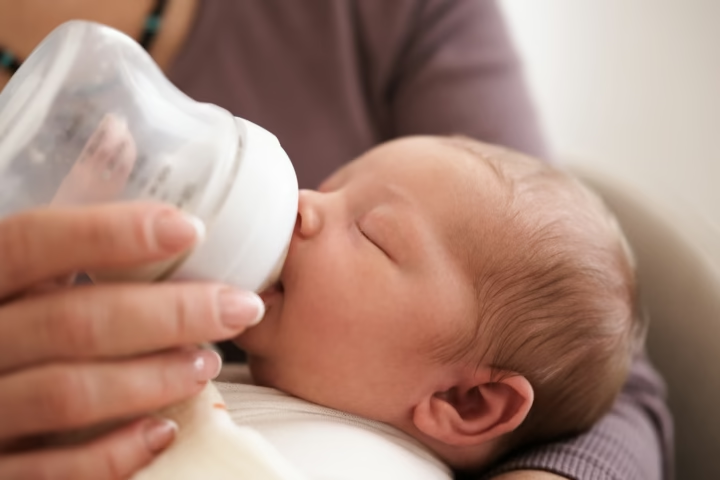
Starting solids does not mean abruptly replacing breast milk or infant formula.
CDC guidance states that breast milk and/or infant formula remain the main source of nutrition from 6 to 12 months while complementary foods gradually increase.
If breastfeeding, formula intake, pumping, or weight gain has already been a concern, ask how the pediatrician wants you to sequence milk and solids.
Useful questions include:
- Should we offer milk before solids at first?
- When might solids begin replacing part of a milk feeding?
- Is my baby’s current milk intake appropriate?
- What signs would suggest solids are displacing too much breast milk or formula?
There is no need to race toward three full meals on the first week.
14. “How Do We Know When the Baby Is Hungry or Full?”
Responsive feeding remains useful when the food changes from milk to solids.
According to the CDC, a baby 6 to 23 months old may show hunger by reaching for food, opening their mouth when food is offered, or becoming excited when they see food. Fullness cues can include pushing food away, closing the mouth, or turning the head away.
The CDC advises allowing the child to decide how much to eat rather than requiring them to finish all the food offered.
Ask:
“What hunger and fullness cues should we watch for at this age?”
This helps move the conversation away from rigid serving targets.
15. “When Can We Offer Water?”
Once solids begin, families often wonder whether water should begin too.
Current CDC guidance says small amounts of water can be offered from around 6 months while breast milk or infant formula remain the primary milk drinks.
Ask whether your baby is ready to practice drinking from an open cup, straw cup, or another developmentally appropriate cup.
The goal at first may be as much about learning the drinking skill as hydration.
Water Does Not Replace Milk Feedings
Milk feeding remains nutritionally important during the first year.
Do not substitute large amounts of water for breast milk or formula without discussing your baby’s feeding needs with a healthcare professional.
16. “What Foods or Drinks Should We Avoid Before Age 1?”
This deserves a specific conversation because several restrictions are easy to confuse.
Honey
Do not give honey to babies younger than 12 months because of the risk of infant botulism. That includes honey added to food, formula, water, or a pacifier.
Cow’s Milk as a Drink
Cow’s milk should not replace breast milk or infant formula as the main drink before 12 months. CDC guidance notes nutritional and gastrointestinal reasons for waiting.
That does not mean all dairy must be avoided before age 1. Pasteurized yogurt and cheese without added sugars can be introduced in developmentally appropriate forms.
Juice
CDC guidance says children younger than 12 months should not drink fruit or vegetable juice. Whole fruit provides more nutritional value.
Added Sugars
Foods and drinks with added sugars should be avoided for infants and young children.
Unpasteurized Foods
Unpasteurized milk, juice, yogurt, and cheese can contain harmful bacteria and should not be given to young children.
Ask your pediatrician whether your family’s usual foods contain anything that needs modification before sharing them with the baby.
17. “Do We Need Rice Cereal?”
No specific first food is required for every baby.
The AAP and CDC do not require parents to begin with rice cereal. For most children, foods do not need to be introduced in a particular order.
If you want to use infant cereal, choose iron-fortified varieties and rotate grains rather than using only rice cereal.
You can also discuss other iron-rich first foods with your pediatrician.
The first food might reasonably be infant oatmeal, meat, beans, vegetables, fruit, egg, yogurt, or another developmentally appropriate food depending on your baby’s needs and your family’s diet.
18. “Should We Put Cereal in the Bottle?”
For routine feeding, no.
The CDC states that putting infant cereal or other solid food in a bottle does not make a baby sleep longer and can increase choking risk.
If a clinician has specifically recommended thickened feeds for a medical problem, follow the individualized plan they provide rather than general internet instructions.
Do not add cereal simply in hopes that a baby will stay full longer or sleep through the night.
19. “Do We Need to Wait Several Days Between Every New Food?”
Current CDC guidance recommends starting with one single-ingredient food at a time and waiting 3 to 5 days between new foods initially, which can make a reaction easier to connect to a specific food.
Allergen introduction creates an additional consideration because current AAP guidance also emphasizes avoiding unnecessary delays in introducing common allergenic foods once a baby is ready.
That makes this a good question for your pediatrician:
“How long do you want us to wait between new foods, especially while we are introducing allergens?”
The answer may depend on your baby’s allergy risk and the clinician’s preferred approach.
20. “What Changes in Poop Are Normal After Starting Solids?”
Food changes stool.
Color, consistency, frequency, and smell can all change after solids begin.
The AAP notes that stools may become more solid, vary in color, smell stronger, and sometimes contain recognizable pieces of food as babies begin complementary feeding.
Ask your pediatrician what should prompt a call, particularly if you are concerned about persistent diarrhea, constipation, blood, mucus, vomiting, or poor feeding.
Photos can be useful when a stool looks unusual but the diaper will obviously not be available at the appointment.
21. “When Should We Worry About Refusing Solids?”
Mess, grimacing, spitting food out, and eating very little are common at the beginning.
Babies are learning a new motor skill and experiencing textures they have never encountered.
The AAP recommends starting with very small amounts and not forcing a baby to eat if they cry or turn away.
Still, persistent feeding difficulty deserves attention.
Ask your pediatrician what would make them concerned about:
- consistently refusing all solids;
- frequent coughing during meals;
- repeated choking;
- inability to progress beyond one texture;
- recurrent vomiting;
- significant distress around feeding;
- poor growth;
- difficulty moving food in the mouth;
- taking unusually long to eat.
These symptoms do not all mean there is a feeding disorder, but they can help determine whether additional evaluation is appropriate.
22. “Would My Baby Benefit From a Feeding Therapist, Dietitian, or Allergist?”
Most babies do not need a specialist before starting solids.
Some do.
Depending on the issue, your pediatrician may recommend a pediatric dietitian, allergist, speech-language pathologist, occupational therapist, gastroenterologist, or another specialist.
Ask whether referral is appropriate if your baby has a history of severe eczema, food reactions, swallowing problems, developmental delays, significant growth concerns, or persistent difficulty progressing with feeding.
Early referral can sometimes prevent months of trial and error when a specific problem is already apparent.
The Starting Solids Questions Checklist
Bring this list to your baby’s appointment and mark the questions that apply to your family.
Readiness
☐ Does my baby look developmentally ready for starting solids?
☐ Is head and trunk control adequate for feeding?
☐ Does prematurity or corrected age change our timing?
☐ Does reflux, growth, or another medical issue affect the plan?
Nutrition
☐ Which iron-rich foods should we prioritize?
☐ Does my baby need an iron supplement?
☐ Should we continue vitamin D?
☐ Is there another nutrient you want us to pay particular attention to?
☐ How much solid food should we offer at first?
☐ How should solids fit around breast milk or formula?
Allergies
☐ When should we introduce peanut?
☐ Does eczema or egg allergy change how we introduce peanut?
☐ When should we introduce egg, dairy, wheat, sesame, soy, fish, and shellfish?
☐ How should these foods be prepared safely?
☐ What symptoms suggest a food allergy?
☐ Which symptoms mean we should call 911?
☐ How often should we continue offering an allergen once it is tolerated?
Feeding Method
☐ Are purees, baby-led weaning, or a mixed approach appropriate for our baby?
☐ What texture should we start with?
☐ When should we progress to thicker textures or finger foods?
☐ Is my baby ready to practice with a cup?
Safety
☐ Which foods are choking hazards right now?
☐ Can you explain gagging versus choking?
☐ Where can we take an infant CPR and first aid course?
☐ Is there anything about our baby’s history that increases feeding or choking risk?
Foods and Drinks
☐ Can we offer water now?
☐ Which foods or drinks should we avoid before age 1?
☐ Do you recommend infant cereal, and which grains?
☐ Is homemade baby food appropriate for us?
☐ How long should we wait between new foods?
Follow-Up
☐ What feeding problems should prompt a call to your office?
☐ What would make you refer us to an allergist, dietitian, or feeding therapist?
☐ What feeding skills should our baby develop before the next well-child visit?
What to Bring to the Pediatric Visit
You can make the conversation much more specific by bringing a few pieces of information.
Consider having:
- your baby’s current breast milk or formula feeding pattern;
- a list of vitamins and supplements;
- any history of eczema;
- details or photos of previous suspected food reactions;
- a list of known allergies in your baby;
- information about prematurity or feeding therapy if not already in the medical chart;
- three or four foods you are considering as first foods;
- your preferred feeding method, if you have one;
- your top concerns about choking or allergies.
You do not need to arrive with a complete menu.
The purpose is to give your pediatrician enough context to identify anything that should change the standard starting solids plan.
Common Questions About Starting Solids
Can Babies Start Solids Before 6 Months?
Most babies begin complementary foods at about 6 months.
The CDC says introduction before 4 months is not recommended. Developmental readiness should be considered along with age.
If you are thinking about starting between 4 and 6 months, discuss your baby’s specific readiness and medical history with the pediatrician first.
Does a Baby Need Teeth to Start Solids?
No.
Readiness depends more on head control, sitting ability, oral-motor skills, and the ability to safely manage food than on having erupted teeth.
Foods should still be prepared in textures your baby can manage safely.
Should Vegetables Come Before Fruit?
There is no evidence that introducing fruit first automatically causes a baby to reject vegetables later.
The AAP states that foods do not need to be introduced in a specific order for most babies.
Variety over time matters more than winning a fruit-versus-vegetable debate.
What Is the Best First Food?
There is no single best first food for every baby.
A useful first food is developmentally safe, nutritionally useful, easy for your baby to manage, and practical for your family.
Iron-rich options deserve particular attention once complementary feeding begins.
Should We Start With One Meal a Day?
Many families begin with one small feeding opportunity and gradually increase frequency as the baby develops.
At the beginning, a few tastes may be enough.
Breast milk or infant formula remains the main source of nutrition from 6 to 12 months.
Does Starting Solids Help a Baby Sleep Through the Night?
Solid food should not be introduced as a sleep treatment.
The CDC specifically states that adding cereal or solid food to a bottle does not make babies sleep longer and may increase choking risk.
Sleep development and complementary feeding are separate issues.
Is Gagging Normal When Starting Solids?
Some gagging can occur as babies learn new textures and oral movements.
However, parents should learn the difference between gagging and true choking. If your baby repeatedly coughs, chokes, struggles to swallow, or appears distressed during feeding, tell your pediatrician rather than assuming every episode is normal.
Can Babies Have Peanut Butter?
Yes, peanut-containing foods can be introduced when appropriate, but whole peanuts and thick spoonfuls of peanut butter are choking hazards.
Use an infant-safe consistency. Babies with severe eczema, egg allergy, or previous food reactions should have an individualized discussion about peanut introduction.
Can Babies Have Yogurt Before Age 1?
Yes, pasteurized yogurt without added sugars can be introduced before age 1 in a developmentally appropriate form.
The restriction on cow’s milk before 12 months refers to using it as a primary beverage, not to every dairy food.
Can Babies Have Honey Cooked Into Food?
Honey should be avoided before 12 months, including honey added to foods.
Can Babies Drink Juice?
Children younger than 12 months should not be given fruit or vegetable juice.
Whole fruit is generally the more useful option.
If You Only Ask Your Pediatrician Seven Questions
A long checklist is useful for reference, but you do not need to turn a well-child visit into an interview.
If time is limited, ask these seven:
- Is my baby developmentally ready for starting solids?
- Which iron-rich foods should we prioritize?
- Does my baby’s eczema or medical history change how we introduce allergens?
- What textures are safe for my baby right now?
- How should we recognize and respond to choking or an allergic reaction?
- How should solids fit around breast milk or formula?
- What feeding problem would make you want us to call or come back sooner?
Those questions cover readiness, nutrition, allergy prevention, feeding safety, and follow-up.
They also give your pediatrician enough room to identify an issue you may not have known to ask about.
Starting solids should gradually expand your baby’s nutrition and feeding skills. It does not need to become a test of whether you chose the perfect first food, bought the right feeding system, or followed one feeding philosophy.
Use the pediatric visit to establish what is safe and appropriate for your baby, then let experience do some of the teaching.
Editorial medical note: This article provides general educational information and does not replace individualized medical care. Feeding recommendations can differ for babies with prematurity, poor growth, swallowing disorders, severe eczema, food allergies, developmental conditions, or other medical concerns.
Key Takeaways
- Most babies begin starting solids around 6 months, once they show developmental readiness. Introducing solids before 4 months is not recommended.
- Ask your pediatrician about iron early. Iron-containing foods become important as complementary feeding begins.
- Do not routinely delay common allergens once a baby is ready for solids. Babies with severe eczema or egg allergy need individualized guidance about peanut introduction.
- Food texture, shape, supervision, and positioning matter for choking prevention. Whole nuts, whole grapes, popcorn, chunks of nut butter, and several other foods are choking hazards.
- Breast milk or infant formula remains the main source of nutrition from 6 to 12 months while solid foods gradually become more important.
- Honey, juice, and cow’s milk as a main beverage should wait until after 12 months. Pasteurized yogurt and cheese can be introduced earlier.
Community
Which question about starting solids did you wish you had asked before your baby’s first bite: allergens, choking, baby-led weaning, iron, portions, or something else? Share the question with other BabyCareGuide parents. Feeding experiences can provide useful perspective, but medical and allergy decisions should remain individualized with a pediatrician.
Save
Starting solids changes quickly as your baby moves from first tastes to thicker textures, allergens, finger foods, and cup practice. Save this guide on your phone and bring the checklist back to your baby’s next well-child visit.
Share
If a partner, grandparent, nanny, or daycare provider will feed your baby, share the safety sections with them. Everyone who serves food should understand your baby’s allergen plan, choking precautions, and foods to avoid.