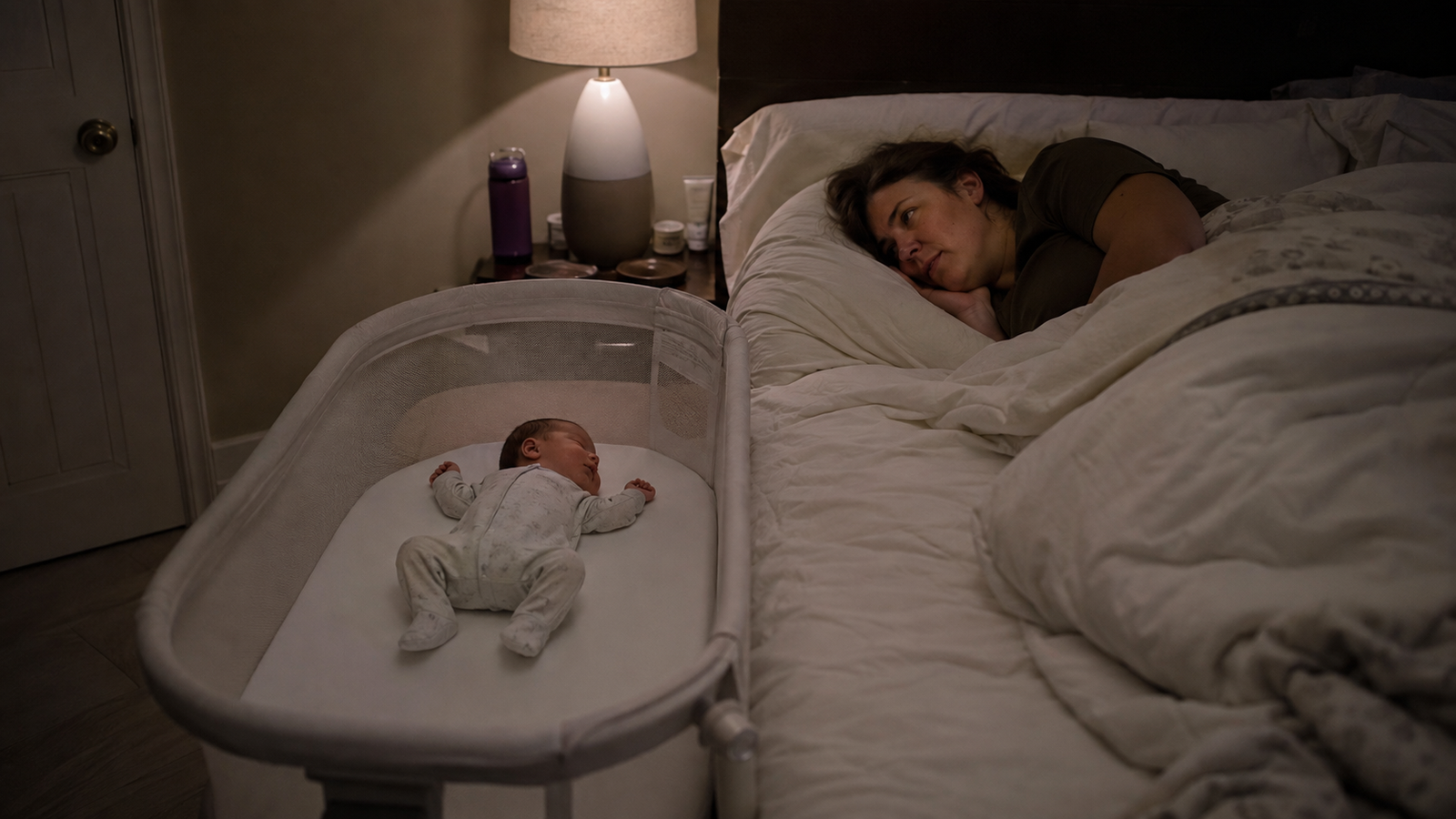
Most newborns sleep about 16 to 17 hours across a 24-hour day, but that sleep is usually divided into short stretches. Waking every one to four hours can be normal, particularly because young babies need frequent feedings and do not yet have mature day-night sleep patterns.
For tired families, the most useful expectation is not that a newborn should “sleep through the night.” It is that sleep will probably be fragmented for a while. The early goal is to protect safe sleep, adequate feeding and parental rest wherever practical, rather than trying to force an adult-style schedule onto a very young baby.
What Newborn Sleep Actually Looks Like
A newborn can spend most of the day asleep and still leave their parents severely sleep deprived.
The reason is simple: total sleep and continuous sleep are very different things.
The American Academy of Pediatrics notes that newborns commonly sleep about 16 to 17 hours per day. However, they may sleep for only one or two hours at a time. Many wake every two to four hours throughout both day and night.
That means a baby who sleeps for 16 hours is not necessarily sleeping from 8 p.m. until morning. Those 16 hours might be spread across numerous naps and nighttime stretches separated by feeding, diaper changes, crying, burping and soothing.
For adults accustomed to getting most of their sleep in one nighttime block, this fragmentation is often the hardest part of newborn care.
Frequent Night Waking Is Usually Part of Newborn Biology
Young babies do not arrive with an adult circadian rhythm, the internal biological system that helps distinguish day from night.
Their sleep is distributed across the full 24-hour day. Their small stomachs also contribute to frequent waking because they need regular opportunities to feed. The National Institute of Child Health and Human Development notes that newborns sleep extensively during both day and night because their internal clocks are not yet established.
The AAP similarly describes frequent nighttime waking as normal during infancy, particularly when babies need to feed.
A newborn waking at midnight, 2 a.m., 4 a.m. and again before sunrise may therefore be exhausting without necessarily having a sleep problem.
Newborn Sleep Expectations During the First Few Months
Sleep development does not follow a precise calendar. Babies vary substantially, so the following periods are better understood as common patterns rather than deadlines.
The First Two Weeks
During the earliest days, sleep, feeding and brief periods of alertness tend to cycle around the clock.
Some newborns appear extremely sleepy. Others wake frequently and need considerable help settling again. Day and night may seem almost interchangeable.
Feeding deserves more attention than creating a sleep schedule during this period. Your pediatrician may give specific instructions about whether your baby should be awakened for feedings, particularly if there are concerns about weight gain, jaundice, prematurity or feeding effectiveness.
Healthy full-term babies may eventually move toward responsive feeding, but families should follow the feeding plan recommended for their baby’s circumstances rather than allowing a very young newborn to skip multiple feeds simply because they remain asleep.
About Two to Six Weeks
Sleep is usually still irregular.
A baby may have one relatively calm night followed by a night of frequent waking. Longer daytime sleep followed by greater nighttime alertness is also common because the baby’s distinction between day and night is still developing.
Parents can begin creating contrast between daytime and nighttime without expecting a schedule to appear immediately.
During the day, normal household light and activity are reasonable. At night, keep feedings and diaper changes quieter, use dimmer lighting and avoid turning nighttime waking into prolonged playtime. The goal is to provide consistent environmental cues, not to keep an exhausted newborn awake during the day.
About Six to Twelve Weeks
Some families begin noticing a somewhat longer first stretch of nighttime sleep and longer periods of alertness during the day.
Others do not.
That difference alone does not mean one baby is a “good sleeper” and another has a problem.
The AAP notes that babies do not develop regular sleep cycles until later in infancy, with guidance commonly placing greater emphasis on more established sleep patterns around 4 months and beyond.
Progress during the newborn period is often uneven. A four-hour stretch one night does not guarantee another four-hour stretch the next night.
How Long Should a Newborn Sleep at One Time?
There is no single normal sleep stretch for every newborn.
One or two hours can be normal. So can somewhat longer periods between feeds, depending on the baby’s age, feeding pattern, health and weight gain.
Rather than evaluating newborn sleep by a target number of nighttime hours, look at the larger picture:
- Is the baby feeding effectively?
- Are growth and weight gain progressing appropriately?
- Is the baby waking and responding normally?
- Are diaper patterns appropriate for their age and feeding situation?
- Has the pediatrician given instructions about waking for feeds?
A long sleep stretch is not automatically better if it interferes with a feeding plan for a baby who needs to eat more frequently.
What Does “Sleeping Through the Night” Mean for a Newborn?
Parents often hear that another person’s baby is already “sleeping through the night,” but the phrase can create unrealistic comparisons.
Some clinical resources use six to eight consecutive hours as a practical definition. Even by that definition, this is generally not something families should expect from a newborn. Stanford Medicine Children’s Health notes that many babies do not begin sleeping for a six-to-eight-hour stretch until at least around 3 months, with substantial variation among infants.
A baby who wakes repeatedly during the newborn period can therefore be developing normally.
Sleep should also not become a competition. Two babies of the same age can have quite different nighttime patterns while both remain healthy.
Feeding and Newborn Sleep Are Closely Connected
Sleep advice for older babies does not always translate well to newborns because feeding remains central during the first weeks.
Many newborns eat approximately every two to three hours, although patterns vary according to age, feeding method, milk transfer, growth and individual medical circumstances.
Cluster feeding can make sleep appear even more unpredictable. A baby may request several feeds relatively close together and later sleep for a longer period.
For breastfeeding families, the frequency of feeding also helps establish and maintain milk production during the early weeks.
If your newborn consistently sleeps through expected feeds, is difficult to wake, feeds weakly or has been given a specific feeding schedule because of weight or medical concerns, contact the pediatrician rather than changing the feeding plan based on general sleep advice.
Should You Wake a Sleeping Newborn to Feed?
Sometimes.
There is no responsible universal answer because the decision depends on factors such as the baby’s age, birth history, current weight, weight trajectory, feeding effectiveness and medical condition.
Some newborns need to be awakened for feeds during the early weeks. Premature infants, babies with jaundice, babies with low birth weight and babies who are not gaining adequately may receive more specific feeding instructions.
Once feeding and weight gain are well established, a pediatrician may advise that some babies can sleep longer between certain feeds.
The practical rule is simple: if your baby’s clinician has told you to wake them to eat, a long sleep stretch does not override that instruction.
Safe Sleep Matters More Than Getting a Longer Stretch
Extreme fatigue can make unsafe sleep arrangements feel tempting at 3 a.m. Unfortunately, several strategies that appear to help babies sleep longer can increase the risk of suffocation or other sleep-related infant deaths.
The American Academy of Pediatrics recommends placing infants on their backs for every sleep, on a firm, flat and noninclined surface designed for infant sleep. The sleep area should contain a fitted sheet and remain free of pillows, loose blankets, crib bumpers, stuffed animals and other soft objects.
The CDC supports the same recommendations.
For at least the first six months, the AAP recommends room sharing, meaning the baby sleeps near the parents but on a separate infant sleep surface such as an approved crib, bassinet or portable play yard.
A Basic Safe Sleep Checklist
For every nap and nighttime sleep:
- Put the baby down on their back.
- Use a firm, flat sleep surface intended for infants.
- Use only a fitted sheet on the mattress.
- Keep blankets, pillows, toys, bumpers and positioners out.
- Keep the baby’s sleep space separate from the adult bed.
- Avoid routine sleep in couches, armchairs, swings and sitting devices.
- Move a baby who falls asleep in a car seat, stroller, swing or carrier to an appropriate firm sleep surface as soon as practical once the travel or activity has ended.
These rules apply even when a particular product appears comfortable or when a baby seems to sleep longer in it.
What About Reflux and Sleeping on an Incline?
Parents sometimes assume that babies who spit up should sleep elevated.
Current AAP guidance does not recommend inclined sleep for infants, including babies with gastroesophageal reflux. Babies should still be placed flat on their backs unless their medical team has given specific instructions for an unusual medical situation.
Sleep products inclined more than 10 degrees are not considered safe infant sleep surfaces under AAP guidance.
Do not place pillows, towels, wedges or other objects underneath or around a newborn to create an incline.
Is Swaddling Safe for Newborn Sleep?
Swaddling can help calm some newborns, but it does not reduce the risk of SIDS.
If you swaddle, the baby should always be placed on their back. The swaddle should not interfere with breathing or normal hip movement, and the baby’s head should remain uncovered.
Stop swaddling as soon as the baby shows signs of attempting to roll. Rolling often develops later, but some babies begin attempting it earlier than expected. Weighted swaddles and weighted blankets are not recommended.
A regular sleep sack that does not restrict the baby’s arms and body may remain useful after swaddling ends, provided the product is appropriate for the baby’s size and used according to manufacturer instructions.
A Practical Night Routine for Tired Families
A newborn routine does not need to be an elaborate bedtime ritual.
At this age, consistency can be as simple as repeating the same small sequence:
Feed the baby. Burp if needed. Change the diaper when necessary. Dim the lights. Use a brief calming technique. Place the baby on their back in the bassinet or crib.
The AAP advises keeping nighttime interactions relatively quiet and unstimulating, which can gradually reinforce the difference between daytime and nighttime.
The routine should support sleep rather than become another task exhausted parents feel obligated to perform perfectly.
Make the Parents’ Sleep Part of the Plan
Newborn sleep advice often concentrates exclusively on changing the baby. In the earliest weeks, improving the adults’ opportunity to sleep can sometimes be more realistic than trying to make the newborn sleep longer.
If two adults are available, consider dividing responsibilities in a way that creates at least one protected rest period.
Depending on feeding circumstances, that might mean one person handles diapering and settling after feeds, one adult takes an early-evening shift while the other sleeps, or a partner manages nonfeeding tasks so the breastfeeding parent can return to sleep sooner.
Families using expressed milk or formula may have additional options for sharing certain feeds, depending on their feeding plan.
The exact arrangement matters less than avoiding the situation where every adult wakes fully for every routine newborn task.
Prepare for the Feed Before You Are Exhausted
Nighttime feeding becomes harder to manage safely when parents are already barely awake.
Before bed, place commonly needed items within easy reach. Depending on your situation, that may include water for the feeding parent, burp cloths, feeding supplies, diapers and a dim light.
Think in advance about where nighttime feeds will happen.
The AAP specifically warns against feeding a baby on a couch or armchair if there is a possibility that the adult may fall asleep. Sofas and upholstered chairs are particularly dangerous places for an infant when an exhausted caregiver dozes off.
If you unexpectedly fall asleep while feeding, move the baby back to their own safe sleep surface as soon as you wake.
Accept Help That Actually Creates Sleep
Visitors who want to “help with the baby” may not reduce parental exhaustion if the parents remain awake hosting them.
More useful help may involve:
- preparing meals;
- washing bottles or pump parts;
- doing laundry;
- grocery shopping;
- watching older children;
- holding an awake baby while a parent rests;
- taking an agreed-upon care shift after receiving safe sleep instructions.
Anyone caring for the newborn should follow the same sleep safety rules. A grandparent’s previous experience does not make outdated sleep practices safer.
Don’t Chase a Rigid Newborn Schedule
A strict by-the-clock sleep schedule is usually a poor match for newborn physiology.
Newborn sleep varies from day to day, and feeding needs can alter the pattern quickly. A routine can be useful. A rigid schedule that requires keeping a hungry baby waiting or deliberately eliminating needed feeds is different.
In this stage, it often makes more sense to think in terms of a flexible rhythm:
feed, brief awake period, soothe, sleep, repeat.
Some cycles will be short. Others will last longer.
A predictable schedule generally becomes more realistic as sleep-wake regulation matures.
Don’t Compare Your Newborn’s Sleep to Social Media
Online sleep discussions frequently compress a complicated situation into one number: how many hours the baby slept.
That leaves out important context.
A five-hour stretch can mean something different for a healthy 11-week-old gaining weight appropriately than for a 6-day-old who is difficult to wake and has feeding concerns.
Likewise, one family’s report of “sleeping through the night” tells you little about how the baby was fed, how the term was defined, whether the pattern happens consistently or whether an adult is repeatedly replacing a pacifier without counting those episodes as waking.
Compare your baby’s pattern with their own health, feeding and development, not someone else’s highlight reel.
When Newborn Sleepiness May Be a Medical Concern
Newborns sleep extensively, so distinguishing ordinary sleep from concerning lethargy can be difficult.
A sleeping baby who wakes, feeds normally and behaves as expected when awake is different from a baby who suddenly becomes difficult or impossible to wake.
Seek urgent medical guidance if a newborn:
- cannot be awakened;
- becomes unusually difficult to wake;
- appears very weak or floppy;
- has a weak suck or cannot feed normally;
- develops significant difficulty breathing;
- has blue or gray lips, tongue or face;
- shows a substantial change from their usual behavior.
A baby younger than 3 months with a rectal temperature of 100.4°F (38°C) or higher needs prompt medical evaluation, even if the baby otherwise appears well.
If something about your newborn’s sleep seems markedly different from their usual pattern, particularly when feeding, breathing, color, temperature or alertness has also changed, contact the pediatrician.
Common Questions About Newborn Sleep
Is it normal for my newborn to wake every two hours?
Yes, it can be. Many newborns wake every one to four hours, and some wake even more frequently during certain periods. Frequent feeding and short sleep cycles contribute to this pattern.
What matters is the baby’s overall health, feeding and growth rather than the number of hours between every individual waking.
Why does my newborn sleep all day and stay awake at night?
Newborns do not yet have mature day-night rhythms. Their internal clock develops gradually.
Expose your baby to normal daylight and household activity during daytime hours, while keeping nighttime feeding and care quieter and dimmer. This may help establish environmental cues, although it will not reverse the pattern instantly.
Should the house be completely quiet while a newborn naps?
It usually does not need to be.
Normal household sounds during the day can coexist with newborn sleep. At night, reducing stimulation can help create a contrast between daytime and nighttime.
You do not need to organize the entire household around perfect silence every time the baby sleeps.
Can I let my newborn nap in a swing?
Swings and other sitting devices are not recommended as routine infant sleep locations.
If the baby falls asleep in a swing, stroller, carrier or car seat outside its intended travel use, the AAP recommends moving the baby to a firm, flat infant sleep surface as soon as practical.
Can a newborn sleep on my chest?
Holding a sleeping newborn while you are fully awake is different from creating an infant sleep environment.
The danger increases if the adult becomes sleepy or falls asleep, particularly on a couch, recliner, armchair or adult bed. If you feel yourself becoming drowsy, transfer the baby to their own safe sleep surface.
Do I need to teach my newborn to self-soothe?
You do not need to make independent sleep a performance target during the earliest weeks.
Simple routines and opportunities to settle in the crib can be introduced gradually, but newborn sleep is still biologically immature. More structured sleep expectations become increasingly relevant as the baby’s sleep cycles organize over the following months.
Responding to a young newborn’s feeding and comfort needs does not mean you have “ruined” their future sleep.
When will my baby sleep longer?
There is no reliable date.
Some babies begin producing longer nighttime stretches during the first few months. Others take considerably longer.
A useful sign of progress is not necessarily eight uninterrupted hours. It may be a first stretch that gradually moves from two hours to three, then occasionally four, combined with more alert daytime periods.
A 2 A.M. Newborn Sleep Check
When your baby wakes again and you are too tired for complicated advice, use a simple sequence.
First, consider feeding. Does your baby show hunger cues, or is it time to feed based on the plan you received from your pediatrician?
Next, check basic comfort. Does the diaper need changing? Is the baby’s clothing appropriate for the room? Do they need burping or brief soothing?
Then keep the environment calm. Use low light and minimal stimulation.
Finally, return the baby to a safe sleep space on their back.
If the baby seems unusually difficult to wake, cannot feed normally, has abnormal breathing, changes color, develops a fever or simply appears significantly different from usual, stop treating the problem as ordinary sleep disruption and seek medical guidance.
What to Focus on This Week
For most families with a healthy newborn, four priorities matter more than achieving a perfect sleep schedule:
Feed the baby according to their individual feeding plan.
Use a safe sleep environment every time.
Expect frequent waking rather than interpreting it automatically as a sleep disorder.
Organize adult responsibilities so that each available caregiver gets meaningful opportunities to rest.
Newborn sleep tends to change in small increments rather than through one dramatic breakthrough. As your baby’s feeding capacity, circadian rhythm and sleep organization mature, longer stretches may gradually appear.
Until then, the safest target is not a newborn who never wakes. It is a baby whose needs are being met safely and a family that has arranged as much sustainable rest as their circumstances allow.
Community
What surprised you most about newborn sleep: the total number of hours, the short stretches, day-night confusion or the frequency of nighttime feeds? Share what your first weeks looked like with other BabyCareGuide parents. Family experiences can help normalize the range of newborn sleep, although medical and safe sleep questions should still be discussed with a pediatrician.
Save
Newborn sleep can change noticeably over the first few months. Save this guide on your phone so you can revisit the expectations, safe sleep checklist and warning signs as your baby’s nighttime pattern develops.
Share
If a partner, grandparent or other caregiver will be helping with nighttime care, send them this guide so everyone is working from the same safe sleep expectations.