During the first weeks, newborn diaper changes do more than keep a baby clean. Wet and dirty diapers can help parents and pediatricians assess whether feeding is going well, whether urine output is increasing as expected, how the baby’s stool is transitioning after birth, and whether there are signs that need closer attention.
The numbers change quickly during the first few days. The American Academy of Pediatrics notes that parents can generally expect at least one wet and soiled diaper on day 1, two on day 2, and three on day 3. After the first four to five days, most newborns should have at least five to six wet diapers in 24 hours.
Poop changes quickly too. The first bowel movements are usually black or dark green meconium. Over the following days, stool should transition toward lighter green, yellow, tan, or brown depending partly on whether the baby receives breast milk, formula, or both.
The important point is not to judge one diaper in isolation. Patterns matter more. A sudden decline in wet diapers, persistent dark urine, failure to transition away from meconium, blood, white stool, fever, poor feeding, or a baby who seems unwell can justify medical evaluation.
Why Newborn Diapers Tell You More Than You Might Expect
New parents can spend surprising amounts of time discussing diapers.
How many were wet? Was that green color normal? Was there enough poop? Did the baby pee during the change? Is that red mark blood? Does loose stool mean diarrhea?
These questions can sound trivial until you understand that newborns cannot tell you how much milk they consumed or whether they feel dehydrated.
A diaper provides observable information.
Pediatricians routinely ask about urine and stool output during early newborn visits because those patterns can contribute to the assessment of feeding adequacy, hydration, jaundice, digestion, and overall newborn health.
That does not mean parents need to analyze every diaper like laboratory evidence.
It means knowing the broad pattern can be genuinely useful during the first days at home.
How Many Wet Diapers Should a Newborn Have?
The answer depends heavily on the baby’s age in days.
Immediately after birth, urine output is still increasing as feeding becomes established.
The AAP’s newborn assessment guidance gives a simple minimum pattern for the first three days:
- Day 1: at least 1 wet diaper
- Day 2: at least 2 wet diapers
- Day 3: at least 3 wet diapers
After approximately day 4 or 5, a newborn should generally be producing at least five to six wet diapers per day. Breastfed babies who are feeding effectively often reach six or more wet diapers per day by days 5 to 7.
These numbers are useful as general reference points, not as isolated diagnostic tests.
Your pediatrician will also consider feeding behavior, weight change, jaundice, stool transition, alertness, and the baby’s medical history.
Why Wet Diapers Matter During Breastfeeding
Parents who bottle-feed can see approximately how many ounces their baby takes.
Breastfeeding does not provide the same direct measurement.
That makes diaper output one of several practical clues that milk intake is increasing appropriately.
A well-fed breastfed newborn should generally transition toward six or more wet diapers daily by the end of the first week, along with appropriate stool changes and weight progression.
If your baby is producing fewer wet diapers than expected, that does not automatically prove low milk intake. It does, however, give you a reason to look at the rest of the feeding picture.
How Can You Tell Whether a Disposable Diaper Is Actually Wet?
Modern disposable diapers can absorb urine so effectively that a small amount of pee may be difficult to detect.
Some diapers have a wetness indicator that changes color.
If yours does not, compare the weight of a dry diaper with one you know is wet. Parents sometimes find it useful to pour a small measured amount of water into a clean diaper once, simply to understand what wetness feels like.
AAP guidance also notes that highly absorbent diapers can make urine monitoring more difficult during the newborn period.
You do not need to weigh diapers at home unless a healthcare professional has specifically asked you to do so.
For most healthy newborns, counting clearly wet diapers is enough.
What Color Should Newborn Urine Be?
Normal urine is generally light yellow to yellow.
Darker yellow urine is more concentrated. During the first days, some concentration is expected as feeding volume increases.
The broader trend should generally move toward more frequent, paler urine as milk intake becomes established.
The AAP notes that newborns may urinate as often as every one to three hours or as infrequently as four to six times per day once output is established.
Urination should not appear painful. Crying or obvious distress specifically associated with urination deserves discussion with the pediatrician.
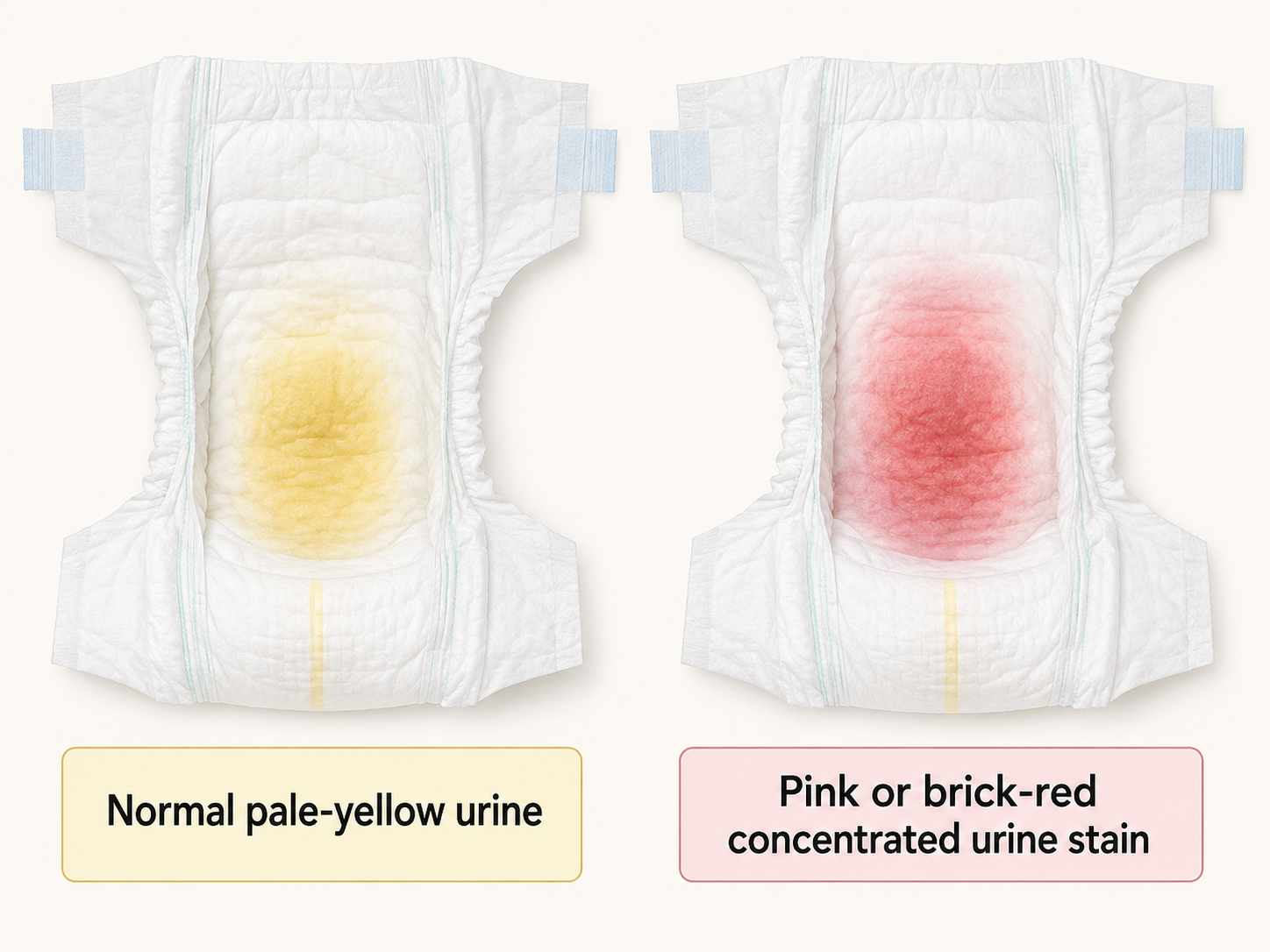
What Is That Pink or Brick-Red Stain in the Diaper?
One of the most alarming newborn diaper changes happens when parents open a diaper and see something pink, orange, or brick red.
During the first week, this can be highly concentrated urine containing urate crystals. Parents sometimes describe the stain as looking like brick dust.
The AAP notes that this pinkish or brick-red staining can occur during the first week and is often mistaken for blood. If the baby is otherwise producing an appropriate number of wet diapers, an isolated occurrence may not indicate a serious problem. Persistent staining should be discussed with the pediatrician.
The context matters.
A pink stain accompanied by declining urine output, poor feeding, increasing jaundice, unusual sleepiness, or other signs that the baby may not be taking in enough milk deserves more attention.
Can Newborn Girls Have Blood in the Diaper?
A small amount of vaginal bleeding can occur during the first days after birth.
This surprises many parents.
Maternal hormones affect a baby’s tissues during pregnancy. After birth, the sudden decline in those hormones can occasionally produce a small amount of blood-tinged vaginal discharge in a newborn girl.
HealthyChildren notes that minor newborn vaginal bleeding may occur during approximately the first 2 to 10 days and usually resolves within a few days.
This is sometimes called pseudomenstruation or “false menses.”
However, do not assume every red spot is hormonal bleeding.
If bleeding is persistent, substantial, occurs after the newborn period, appears to come from the urine or stool, or is accompanied by poor feeding, vomiting, fever, or an ill-looking baby, contact the pediatrician.
What Should the First Newborn Poop Look Like?
The first stool looks very different from ordinary baby poop.
It is called meconium.
Meconium is usually thick, sticky, and black or extremely dark green. It accumulated in the baby’s intestines before birth and is normally passed during the first days of life.
Parents often describe it as tar-like.
It can also be surprisingly difficult to wipe away.
The important change comes afterward.
As breast milk or formula moves through the digestive tract, the stool should begin transitioning away from black meconium toward greenish-brown and eventually toward the baby’s usual milk-fed stool.
When Should Meconium Change to Normal Baby Poop?
The transition usually begins over the first several days.
For breastfed babies, the stools often move from black meconium to greenish transitional stool and then toward loose, yellow, sometimes seedy stools as milk intake increases.
AAP breastfeeding guidance notes that by days 3 and 4, stools should begin appearing greener or yellow, and by days 5 to 7, a well-fed breastfed baby’s stool is generally yellow and soft.
This stool transition is useful because it provides another clue that feeding is progressing.
Persistent black or dark green meconium beyond the period when stools would normally be transitioning can justify a feeding assessment, particularly in a breastfed newborn.
What Does Breastfed Newborn Poop Look Like?
Breastfed newborn poop often surprises parents because it can look extremely loose.
Typical colors include:
- mustard yellow;
- yellow-green;
- green;
- occasionally brownish shades.
The texture may be loose or runny and contain small seed-like particles.
That does not automatically mean the baby has diarrhea.
HealthyChildren notes that normal breastfed stools can be quite loose because food moves rapidly through a young infant’s digestive tract.
In the first month, some breastfed babies stool after many feeds.
Later, frequency can change considerably.
What Does Formula-Fed Newborn Poop Look Like?
Formula-fed stool tends to be more formed than breastfed stool, although it should still be soft.
Typical colors can include:
- yellow;
- tan;
- brown;
- yellow-green;
- green.
The AAP describes formula-fed stool as generally firmer than breastfed stool but still soft, rather than hard or dry.
Parents often compare the consistency to peanut butter or soft clay.
Formula-fed babies may also stool less frequently than breastfed babies.
The number itself matters less than whether the stool remains reasonably soft and the baby feeds, grows, and behaves normally.
Is Green Newborn Poop Normal?
Very often, yes.
Green is one of the normal stool colors in infants.
Bile contributes to the green color, and both breastfed and formula-fed babies can produce green stools.
A single green diaper is rarely useful evidence of a feeding problem by itself.
This is an area where online discussions sometimes create unnecessary anxiety.
Parents may encounter claims that every green stool proves “foremilk-hindmilk imbalance,” food intolerance, or another specific feeding disorder. Stool color alone generally does not establish those diagnoses.
Look at the full pattern.
If the baby is feeding effectively, gaining weight, producing adequate urine, and otherwise well, green stool can fall within normal variation.
Which Poop Colors Deserve a Call to the Pediatrician?
Most shades of yellow, green, tan, and brown are normal.
Three colors deserve more caution: red, black, and white or very pale gray.
Red Stool
Red can represent blood, although not every red appearance is blood.
In a newborn who is not eating red foods, visible blood should be brought to the pediatrician’s attention.
Small streaks can sometimes come from irritation or a tiny anal fissure, but other causes require evaluation.
Black Stool
Black stool is normal while a newborn is passing meconium.
After meconium has cleared, genuinely black, tar-like stool can indicate digested blood and should be discussed with a healthcare professional.
Dark green can sometimes look almost black under poor lighting, so checking the diaper under bright light can help.
White or Chalky-Pale Stool
White, chalky, or very pale stool is not a normal newborn stool color.
The AAP notes that white or colorless stool can be associated with liver or bile-flow problems and should receive prompt medical attention.
If you are uncertain about an unusual stool color, take a clear photo in natural light before throwing the diaper away.
That can be much more useful to a pediatrician than trying to describe the shade later.
How Often Should a Newborn Poop?
There is much more variation in poop frequency than many parents expect.
Some newborns stool after many feedings.
Others stool several times per day.
Feeding method and age both influence the pattern.
In the earliest days, stool output contributes to the assessment of whether milk intake is increasing. By the fourth day, AAP parent guidance describes at least four stools per day as one expected sign of adequate feeding, although the exact pattern differs between breastfed and formula-fed infants.
After the first weeks, frequency can change considerably.
By approximately 3 to 6 weeks, some healthy breastfed babies may go several days or even about a week between bowel movements, provided the stool remains soft and the baby is feeding and growing appropriately.
That is why a poop pattern that would be concerning in the first week may be completely normal in an older breastfed infant.
Age matters.
Does Straining Mean a Newborn Is Constipated?
Not necessarily.
Young babies can grunt, turn red, pull their legs up, and appear to work extremely hard while having a bowel movement.
They are still learning to coordinate abdominal pressure with relaxation of the muscles involved in passing stool.
The consistency of the stool is often more informative than facial expression.
Hard, dry, pellet-like, or unusually firm stools raise more concern for constipation than a baby who strains but eventually passes soft stool.
If your newborn regularly passes hard stool, seems very uncomfortable, has blood associated with hard stools, vomits, feeds poorly, or has a swollen abdomen, contact the pediatrician.
Do not give a newborn juice, water, suppositories, or other constipation treatments unless your healthcare professional recommends them.
How Do You Know Whether Loose Newborn Poop Is Diarrhea?
This can be difficult because normal newborn poop is already loose.
For breastfed babies in particular, watery-looking yellow stool can be normal.
Rather than focusing only on consistency, look for a change from your baby’s usual pattern.
Potential signs of diarrhea can include:
- a sudden increase in stool frequency;
- substantially more water than usual;
- large amounts of mucus;
- blood;
- poor feeding;
- vomiting;
- fever;
- reduced urine output;
- an ill-looking baby.
The AAP emphasizes that dehydration is a primary concern when diarrhea occurs in young infants.
A newborn with significant diarrhea deserves a lower threshold for medical advice than an older child.
When Do Fewer Wet Diapers Become Concerning?
A sudden reduction in urine output deserves attention because it can be a sign that a newborn is not taking in enough fluid.
During the first few days, expected urine output changes daily, so compare the number with your baby’s age.
After feeding has become established, fewer than approximately five to six wet diapers per day can justify checking in with the pediatrician, particularly if the baby is also feeding poorly or losing more weight than expected.
The AAP symptom guidance treats no urine for more than eight hours in a young breastfed baby as a reason for urgent assessment, especially when accompanied by signs such as dry mouth, poor feeding, or an ill appearance.
Do not wait for every classic dehydration sign to appear before calling if a newborn’s urine output has changed substantially.
Newborn Diaper Changes Can Help You Spot Feeding Problems
Diapers are not a perfect measurement of milk intake.
They are one part of a broader picture.
For example, a pediatrician evaluating breastfeeding may consider:
- how often the baby feeds;
- swallowing during feeds;
- urine output;
- stool number and color;
- jaundice;
- weight loss after birth;
- subsequent weight gain;
- whether the baby appears satisfied after feeds.
AAP guidance specifically uses stool and urine output as part of newborn feeding assessment.
This is why keeping a simple diaper log can be useful during the first week.
You probably do not need to continue tracking every diaper for months.
Once feeding, weight gain, and output are clearly established, most families naturally stop counting.
How Often Should You Change a Newborn’s Diaper?
Newborns can require a lot of diaper changes.
AAP parent guidance notes that families may change as many as 8 to 12 diapers per day during this stage.
The practical rule is simpler than an exact schedule:
Change poop promptly and change wet diapers often enough to keep the skin reasonably clean and dry.
Stool is particularly irritating because digestive enzymes remain in contact with the skin.
Frequent changing can reduce that exposure and help prevent irritant diaper dermatitis.
You do not need to wake a sleeping newborn every time a modern disposable diaper contains a tiny amount of urine unless your pediatrician has given specific instructions or the baby has a skin problem requiring more frequent changes.
Feeding schedules often create natural opportunities for nighttime diaper checks.
Do You Need to Use Wipes After Every Pee?
Not necessarily.
AAP guidance notes that urine alone is generally less irritating than stool and that modern disposable diapers absorb much of the moisture.
For a urine-only diaper, wiping at every single change is not always necessary, particularly if the skin is sensitive.
When cleaning is needed, plain water, a damp soft cloth, or fragrance-free wipes can work.
For stool, clean thoroughly but gently.
Repeated aggressive wiping can irritate delicate newborn skin as much as inadequate cleaning.
What Kind of Wipes Are Best for Newborn Skin?
For routine use, simple is usually better.
The AAP recommends choosing wipes without alcohol or fragrance when possible, particularly for sensitive skin. Water and a soft cloth are also reasonable options.
If the diaper area becomes raw or irritated, rinsing with water and patting dry can be less painful than repeated wiping.
Avoid rubbing the skin until it is completely free of every trace of barrier cream.
A protective layer of paste can remain in place if it is not soiled.
How Do You Prevent Diaper Rash?
The most common diaper rash is irritant dermatitis caused by prolonged contact with urine and stool.
Prevention centers on reducing that contact.
Useful steps include:
- changing diapers frequently;
- cleaning stool gently and thoroughly;
- allowing skin to dry before closing the diaper;
- using fragrance-free products when possible;
- avoiding diapers that are excessively tight;
- applying a barrier ointment when the skin is becoming irritated.
Zinc oxide and petrolatum are common barrier ingredients recommended by the AAP.
You do not need a complicated skin-care routine.
The goal is to reduce moisture, friction, and exposure to irritants.
How Much Diaper Cream Should You Use?
Parents often apply less than they need when a significant irritant rash develops.
Barrier cream works by creating a physical layer between irritated skin and the contents of the diaper.
AAP guidance recommends a generous layer of zinc oxide or petrolatum-based barrier paste when treating irritant diaper rash.
If the layer is still clean during the next change, you do not need to scrub all of it away.
Remove stool and obvious contamination gently, then add more barrier cream as needed.
When Is a Diaper Rash More Than Simple Irritation?
Not every red rash is ordinary diaper dermatitis.
A yeast rash, bacterial infection, allergic reaction, or another skin condition can sometimes look similar.
Contact your pediatrician when a newborn rash includes features such as:
- blisters;
- pimples;
- open sores;
- yellow crusting;
- spreading redness;
- bleeding;
- significant raw skin;
- fever;
- a baby who appears ill.
Because babies younger than one month deserve particular caution when infection is possible, AAP symptom guidance recommends medical assessment for very young newborns with concerning diaper-area blisters, pimples, spreading redness, or abnormal behavior.
A rash that repeatedly returns despite careful diaper care also deserves discussion.
Should You Use Baby Powder During Diaper Changes?
Baby powder is generally unnecessary.
The AAP advises parents to avoid talc-containing baby powder because inhaled powder can injure the lungs, and talc can present additional contamination concerns.
Barrier ointment, frequent changes, and gentle skin cleaning are more useful for preventing most diaper irritation.
If you use any powdered product, keep it well away from the baby’s face and avoid creating airborne dust.
How Should You Change a Diaper While the Umbilical Cord Is Still Attached?
During the first one to three weeks, the umbilical cord stump is often still present.
Keep the diaper folded below the stump so urine does not repeatedly soak it and the area remains exposed to air.
The AAP recommends keeping the stump clean and dry rather than routinely applying rubbing alcohol.
A few drops of blood around the time the stump separates can be normal.
Call the pediatrician if you see:
- spreading redness around the base;
- foul-smelling or pus-like discharge;
- significant tenderness;
- active bleeding;
- fever;
- a baby who appears ill.
These can indicate a problem that needs evaluation.
How Do You Clean an Uncircumcised Newborn Penis?
Clean only the outside.
A newborn’s foreskin is normally attached to the head of the penis and usually cannot be retracted.
Do not force it back.
The AAP states that forced foreskin retraction can cause pain, bleeding, and tearing.
Routine external cleaning during baths and diaper changes is sufficient.
The foreskin will separate naturally over time, which may take months or years.
What Should You Expect After Newborn Circumcision?
Follow the specific instructions provided by the clinician who performed the procedure because care varies somewhat depending on technique.
The tip of the penis may initially look red or raw, and a small amount of yellowish material can be part of normal healing.
AAP guidance notes that petroleum jelly is commonly used to prevent the healing area or dressing from sticking to the diaper.
Keep stool away from the healing area and clean gently if contamination occurs.
Contact the pediatrician for increasing redness, swelling, concerning discharge, persistent bleeding, problems urinating, or anything that appears substantially different from the postoperative instructions you received.
Is a Diaper Change Safe on a Bed or Couch?
A changing table is convenient, but it is not required.
A clean towel or changing pad on the floor can work well.
The important safety principle is that a newborn should never be left unattended on an elevated surface.
Even before a baby appears capable of rolling, unexpected movement can occur.
Prepare the diaper, wipes, clothing, and barrier cream before placing the baby on a changing surface so you do not have to turn away to retrieve something.
If you forgot an item, take the baby with you.
What Should You Track During the First Week?
You do not need an elaborate app unless you enjoy using one.
A basic note on your phone can be enough.
For the first days at home, consider recording:
- feeding times;
- whether feeds were breast milk, formula, or both;
- number of wet diapers;
- number and color of stools;
- any vomiting;
- unusual urine or stool appearance.
This information can make the first pediatric follow-up much more productive.
You may not remember whether the baby had four or seven diapers yesterday after several nights of fragmented sleep.
That is normal.
Writing it down removes the need to remember.
A Simple Newborn Diaper Pattern for the First Week
The following is a practical framework rather than a rigid prescription.
Day 1
Expect at least one wet and one soiled diaper.
The stool is usually black or very dark green meconium.
Day 2
Expect output to begin increasing, with at least two wet and soiled diapers as a general minimum.
Meconium is usually still present.
Day 3
At least three wet and soiled diapers is a useful minimum reference point.
Stool should begin transitioning away from thick black meconium toward greenish-brown.
Days 4 and 5
Urine output should continue increasing.
AAP parent guidance describes at least five to six wet diapers daily after approximately the fourth or fifth day. Stool should be transitioning toward the color and consistency expected for the baby’s milk feeding.
Days 5 to 7
A well-fed breastfed baby typically has six or more wet diapers in 24 hours and yellow, soft stools. Formula-fed stool is usually somewhat firmer and may be tan, yellow, brown, or green.
Your pediatrician may use a different target if your baby was premature, has jaundice, is losing more weight than expected, has feeding difficulties, or has another medical concern.
When Newborn Diaper Changes Should Prompt a Call
Diapers are most useful when interpreted alongside the baby’s overall condition.
Contact your pediatrician promptly if you notice:
- substantially fewer wet diapers than expected for age;
- no urine for a prolonged period, particularly around eight hours or more;
- persistent pink or brick-red urine staining;
- painful urination;
- blood in the urine;
- white or chalky stool;
- black stool after meconium should have cleared;
- significant blood in stool;
- large amounts of mucus or unusually watery stool;
- hard, dry stool with significant difficulty passing it;
- persistent meconium when stools should be transitioning;
- worsening diaper rash with blisters, sores, crusting, or spreading redness;
- poor feeding;
- increasing jaundice;
- vomiting or marked lethargy.
AAP guidance advises particular caution when reduced urine output occurs alongside poor feeding or other signs of dehydration.
Fever Changes the Situation
A rectal temperature of 100.4°F (38°C) or higher in a baby younger than 3 months requires prompt medical evaluation.
Do not dismiss fever as a diaper, digestion, or feeding issue.
The AAP specifically recommends contacting a healthcare professional when a young infant has fever, particularly when diarrhea, dehydration concerns, poor feeding, or an ill appearance is also present.
Common Questions About Newborn Diaper Changes
Should I change a newborn before or after feeding?
Either can work.
Some parents change the diaper before a feeding to wake a sleepy newborn. Others change midway through or afterward.
If your baby commonly poops during feeding, waiting until afterward may reduce the chance of completing two changes within ten minutes.
The exception is a heavily soiled diaper. Stool should not remain against the skin unnecessarily.
Do I have to change every wet diaper immediately?
You should change wet diapers regularly, particularly when the diaper feels substantially wet or the skin is irritated.
Modern disposable diapers are highly absorbent, so a small amount of urine does not necessarily require an immediate emergency change.
Poop deserves faster attention because stool is more irritating to the skin.
Should I wake my newborn at night for a diaper change?
If your newborn wakes for a feeding, check the diaper at that time.
A stool-filled diaper should be changed.
Whether a sleeping baby needs to be awakened solely for a urine-only diaper depends on how wet it is, the baby’s skin condition, feeding plan, and any instructions your pediatrician has given.
For most healthy babies with intact skin, every small amount of overnight urine does not require waking the baby immediately.
Why does my newborn pee during diaper changes?
Cool air hitting the skin can sometimes trigger urination.
Keep the clean diaper ready before opening the old one.
For a baby with a penis, covering the penis loosely with the old diaper, a cloth, or the new diaper during cleaning can reduce the chance of an unexpected spray.
Is it normal for my newborn to poop during almost every feeding?
It can be.
Feeding activates the gastrocolic reflex, which stimulates the digestive tract.
Some newborns, particularly breastfed babies, may stool during or shortly after many feedings.
Why is my baby’s poop so runny?
Normal breastfed newborn stool can be very loose.
Diarrhea is usually better recognized by a sudden change from the baby’s normal pattern, especially a sharp increase in frequency or water content combined with other symptoms.
Is mustard-yellow poop normal?
Yes.
Mustard-yellow, loose, sometimes seedy stool is a classic appearance for a breastfed newborn after meconium has cleared.
Is green poop normal?
Usually, yes.
Green is considered a normal infant stool color and often reflects bile.
When is black poop normal?
Black, tarry meconium is normal during the first bowel movements after birth.
Once meconium has cleared and the stool has transitioned, new black tar-like stool should be discussed with the pediatrician.
Is white baby poop normal?
No.
White, gray, chalky, or unusually pale stool warrants medical attention because it can indicate inadequate bile reaching the intestine.
How can I tell if my newborn is dehydrated from the diaper?
Reduced urine output is one important clue.
Other signs can include poor feeding, dry mouth, unusual sleepiness, worsening jaundice, and urine that remains unusually concentrated.
A significant decline in wet diapers or no urine for many hours in a newborn deserves prompt medical advice.
Should I put diaper cream on at every change?
You do not necessarily need barrier cream at every change when the skin is completely healthy.
Some families use a thin protective layer preventively, especially overnight.
If irritation begins, a thicker barrier layer containing zinc oxide or petrolatum can reduce contact between the skin and urine or stool.
Disposable or cloth diapers for a newborn?
Both can work.
Disposable diapers are highly absorbent and can make it easier to keep skin dry. Cloth diapers allow parents to notice urine more readily but generally require more frequent changing because they absorb moisture differently.
The more useful question is which system your family can use consistently while keeping the baby clean, dry, and appropriately monitored.
A 30-Second Diaper Check for Exhausted Parents
At 3 a.m., you do not need to analyze every detail.
Look at four things.
Wetness: Is urine output roughly following the pattern expected for your baby’s age?
Poop: Is stool transitioning appropriately, and is the color generally yellow, green, tan, or brown after meconium clears?
Skin: Is the diaper area intact, or is redness becoming raw, blistered, crusted, or widespread?
Baby: Is your newborn feeding, waking, breathing, and behaving normally?
The fourth question matters most.
One strange-looking diaper in a thriving baby is very different from an abnormal diaper combined with poor feeding, fever, vomiting, significant jaundice, or lethargy.
What Parents Should Remember During the First Weeks
The goal of tracking newborn diaper changes is not to create another task that exhausted parents need to perform perfectly.
It is to notice patterns.
During the earliest days, wet and dirty diapers provide useful information because feeding volume is changing rapidly. Once milk intake and weight gain are established, most parents no longer need to count every diaper.
Remember the broad progression:
Urine output should increase over the first several days.
Meconium should transition toward ordinary milk-fed stool.
Yellow, green, tan, and brown stools are commonly normal.
Red, persistent black, or white stool deserves more attention.
A sudden reduction in urine output matters more than whether one diaper seemed slightly lighter than usual.
And when the diaper looks unusual and the baby seems unwell, the baby’s condition should guide you more than the diaper chart.
If you are uncertain, take a photo, note the number of wet diapers and feeds, and call your pediatrician. Those details can help them decide what should happen next.
Editorial medical note: This article provides general educational information and does not replace individualized medical care. Newborn urine and stool patterns can vary with age, feeding method, prematurity, jaundice, medical conditions, and feeding effectiveness.
Key Takeaways
- During the first three days, AAP guidance describes at least one, two, and three wet and soiled diapers on days 1, 2, and 3, respectively. After approximately day 4 or 5, most newborns should have at least five to six wet diapers per day.
- The first stool is normally black or dark green meconium. It should transition over the following days toward lighter milk-fed stool.
- Yellow, green, tan, and brown are generally normal stool colors. Red, persistent black after meconium, and white or very pale stools deserve medical attention.
- A pink or brick-red stain during the first week can come from concentrated urine, but persistent staining or reduced urine output should be discussed with the pediatrician.
- Frequent diaper changes, gentle cleaning, and a barrier containing zinc oxide or petrolatum can help prevent irritant diaper rash.
- A newborn with significantly decreased urine output, poor feeding, unusual lethargy, concerning stool, or a rectal temperature of 100.4°F (38°C) or higher needs prompt medical guidance.
Community
What surprised you most about newborn diapers during the first week: the black meconium, the number of changes, yellow seedy poop, brick-red urine stains, or how difficult it was to tell whether a disposable diaper was wet? Share your experience with other BabyCareGuide parents, while leaving medical interpretation of concerning urine or stool changes to a pediatrician.
Save
Diaper patterns change quickly during the first week after birth. Save this guide on your phone so you can compare wet diapers, stool transitions, and warning signs when you are tired and trying to remember what is normal.
Share
If a partner, grandparent, or other caregiver is helping with your newborn, share this guide with them. Knowing which diaper changes are ordinary and which ones deserve attention can make feeding and newborn care easier to coordinate.