If you plan to start trying to conceive within the next month, prioritize a short list of high-value steps: start taking 400 micrograms (mcg) of folic acid every day, review your medications and supplements with a healthcare professional, check whether your vaccines are up to date, address any chronic medical conditions, stop drinking alcohol and smoking, and understand when to stop your birth control.
You do not need to complete every health goal before you can try for pregnancy. Some issues, however, need more than a month of lead time. Certain vaccines require waiting before conception, some medications need individualized changes, and the birth control injection can delay the return of fertility.
The purpose of a preconception checklist is to identify those issues early, not to make pregnancy preparation another impossible standard to meet.
The Month Before Trying: What Actually Deserves Priority?
A month can be enough time to make several meaningful changes before conception, but it is not enough time to optimize every aspect of your health.
That distinction matters.
Someone who searches for a preconception checklist can easily end up with a list containing dozens of supplements, laboratory tests, diet rules, fertility gadgets, detox plans, dental procedures, exercise targets, and lifestyle changes. Most people do not need all of them.
For the month before you start trying, priorities can be divided into three categories:
Do now: folic acid, medication review, vaccine review, substance use changes, and management of important health conditions.
Consider based on your circumstances: carrier screening, STI testing, dental care, workplace exposure review, and an earlier fertility consultation.
Do not overcomplicate: expensive fertility supplements, restrictive diets, unnecessary hormone testing, or trying to reach a supposedly perfect weight in four weeks.
Here is how to work through the month practically.
1. Start Folic Acid Today
If you do only one supplement-related task before trying to conceive, make it this one.
The CDC recommends that people who can become pregnant get 400 mcg of folic acid every day. If you are planning pregnancy, the CDC advises starting at least one month before conception and continuing during pregnancy.
Folic acid helps reduce the risk of neural tube defects, serious birth defects affecting the developing brain and spine. The neural tube forms and closes very early in pregnancy, often before someone knows they are pregnant.
That timing explains why waiting for a positive pregnancy test to start folic acid misses part of the preventive window.
Does It Have to Be a Prenatal Vitamin?
Not necessarily, but taking a prenatal vitamin is a convenient way to get folic acid along with other nutrients commonly needed during pregnancy.
Check the supplement facts rather than relying on the word “prenatal” on the front of the bottle. ACOG recommends a prenatal vitamin containing at least 400 mcg of folic acid beginning at least one month before pregnancy.
Also check the ingredient itself. ACOG notes that folic acid is the form of folate proven to help prevent neural tube defects.
An expensive prenatal is not automatically better than an inexpensive one.
Some People Need More Than 400 mcg
Higher-dose folic acid is appropriate in certain circumstances.
For example, ACOG recommends 4 milligrams (4,000 mcg) daily for someone who has had a previous pregnancy affected by a neural tube defect, with supplementation beginning before pregnancy. Other medical histories, including some seizure disorders or medications, may also affect the recommended dose.
Do not simply take several prenatal vitamins to reach a higher folic acid dose. That also multiplies the amounts of other vitamins and minerals.
If you think you may need high-dose folic acid, ask your obstetrician, primary care clinician, neurologist, or another appropriate healthcare professional about the correct dose and timing.
2. Make a Complete Medication and Supplement List
The month before trying is a particularly useful time to examine everything you routinely put in your medicine cabinet.
Include:
- prescription medications;
- over-the-counter medicines;
- vitamins;
- herbal products;
- powders and dietary supplements;
- sleep aids;
- pain relievers;
- acne and skin medications;
- medications taken only occasionally.
The FDA recommends making a pregnancy medication plan with a healthcare provider before conception. Some medicines can be continued during pregnancy, some may require adjustments, and others may have safer alternatives.
Do Not Stop Prescription Medication on Your Own
Finding a warning online about a medication can make stopping it immediately seem safer.
That can be the wrong decision.
ACOG specifically advises against stopping prescription medication without first discussing it with an obstetric care provider. For some health conditions, the risks associated with untreated disease can outweigh medication-related risks.
This is especially relevant for medications used for conditions such as:
- epilepsy;
- depression, anxiety, bipolar disorder, or other mental health conditions;
- diabetes;
- high blood pressure;
- autoimmune disease;
- thyroid disorders;
- migraine;
- blood clotting disorders;
- chronic pain.
The question is not simply, “Is this drug safe?”
A more useful set of questions is:
- Do I still need this medication?
- Is the dose appropriate if I become pregnant?
- Is there a preferred alternative?
- Does this medication require a waiting period before conception?
- What could happen if the condition becomes uncontrolled after stopping treatment?
Some medication changes require more than a month, which is why reviewing them before the first cycle of trying can be valuable.
Do Not Assume “Natural” Means Pregnancy-Safe
Herbal products and supplements deserve the same review.
The FDA cautions against assuming that a product is safe simply because it is labeled natural and recommends discussing medicines, vitamins, and supplements with a healthcare professional.
You usually do not need a shelf full of “fertility” supplements simply because you are preparing to conceive.
3. Schedule a Preconception Visit If You Can
A preconception appointment is different from waiting until you have a positive pregnancy test to establish prenatal care.
The visit gives your clinician a chance to review health issues while there is still time to make changes before pregnancy.
ACOG recommends prepregnancy care and advises discussing medical history, family history, previous pregnancies, medications, vaccines, diet, lifestyle, infection risks, and other individual factors.
Depending on your history, the appointment may include discussion of:
- chronic medical conditions;
- previous pregnancy complications;
- menstrual cycle regularity;
- current medications;
- vaccination records;
- family genetic history;
- carrier screening;
- STI screening;
- cervical cancer screening if due;
- substance use;
- mental health;
- occupational or environmental exposures;
- fertility concerns.
You do not necessarily need a special battery of “preconception labs.” Testing should be driven by your age, medical history, family history, symptoms, and preventive care needs.
4. Make Sure Chronic Conditions Are Managed Before Pregnancy
Pregnancy changes cardiovascular, metabolic, endocrine, and other physiological demands. A condition that is stable outside pregnancy may need different monitoring or treatment during pregnancy.
ACOG recommends addressing medical conditions before conception when possible.
Conditions that deserve particular preconception attention can include:
- type 1 or type 2 diabetes;
- chronic hypertension;
- thyroid disease;
- epilepsy;
- kidney disease;
- heart disease;
- autoimmune disorders;
- significant psychiatric conditions;
- blood disorders;
- obesity or a history of bariatric surgery.
For example, the CDC advises people with type 1 diabetes to have a diabetes management plan in place before pregnancy when possible and to review medications with their healthcare team.
The goal is not perfect health. It is to avoid discovering after conception that an important condition, medication, or monitoring plan should have been addressed earlier.
5. Check Your Vaccine Record Before You Start Trying
Vaccination status is one of the reasons a preconception check can be more useful before pregnancy than after it begins.
Some vaccines can be given during pregnancy when recommended. Others are live vaccines and are not given during pregnancy.
The timing is particularly important for MMR, which protects against measles, mumps, and rubella, and varicella, which protects against chickenpox.
CDC guidance says people planning pregnancy should make sure they are appropriately vaccinated against rubella before becoming pregnant. After receiving MMR, pregnancy should be avoided for at least one month.
The varicella vaccine is also contraindicated during pregnancy, and CDC guidance advises avoiding pregnancy for one month after each dose.
Why This Can Change Your Timeline
Suppose you plan to remove your IUD next week and start trying immediately.
If you discover that you need MMR vaccination, your clinician may advise postponing conception for a month after vaccination. If you need a multidose vaccine series, the timing may require additional planning.
That is a useful reason to look at your vaccination record before stopping contraception rather than during the first prenatal visit.
Your healthcare professional can review your age, medical conditions, vaccine history, travel, work, and other factors against the current CDC immunization schedule.
6. Decide When to Stop Birth Control
You generally do not need a prolonged “hormone detox” before trying to conceive.
For many reversible contraceptive methods, fertility can return quickly after discontinuation.
ACOG states that fertility returns rapidly after IUD or contraceptive implant removal, and a person can start trying to become pregnant after IUD removal.
Birth control pills and vaginal rings also do not appear to cause long-term fertility impairment.
The Birth Control Shot Is an Important Exception
Depot medroxyprogesterone acetate, commonly called the birth control shot or DMPA, can have a considerably longer return-to-fertility period.
ACOG states that it takes an average of about 10 months to become pregnant after stopping the injection, although individual timing varies.
That does not mean the shot causes infertility. It means the contraceptive effect can persist longer after the final injection.
If you currently use DMPA and hope to conceive on a specific timeline, discuss timing with your ob-gyn well before the month you want to start trying.
7. Stop Alcohol When You Start Trying
The CDC recommends not drinking alcohol if you are pregnant or trying to become pregnant.
There is no known safe amount of alcohol during pregnancy, and alcohol exposure can occur in early pregnancy before someone knows they are pregnant.
For that reason, the practical point at which to stop is when you begin trying rather than when a pregnancy test eventually turns positive.
If stopping alcohol is difficult, discuss it with a healthcare professional. That is a medical issue worth addressing directly, not a reason to postpone seeking care.
8. Stop Smoking and Address Nicotine Use
If you smoke cigarettes, quitting before pregnancy is preferable to waiting for a positive test.
The CDC states that smoking can affect reproductive health and is associated with pregnancy complications and adverse infant outcomes. Quitting before pregnancy provides the greatest opportunity to reduce exposure.
This is also a good time to discuss:
- vaping;
- nicotine products;
- marijuana;
- recreational drugs;
- secondhand smoke exposure.
If you need help stopping nicotine or another substance, treatment and support are preferable to trying to manage dependence through willpower alone.
9. Bring Caffeine Into the Pregnancy Range
You do not need to eliminate coffee because you are trying to conceive.
ACOG states that moderate caffeine consumption of less than 200 mg per day does not appear to be a major contributor to miscarriage or preterm birth.
If you currently consume much more than that, the month before trying can be a convenient time to reduce your intake gradually.
Gradual reduction may also be easier than abruptly quitting caffeine the day you see a positive pregnancy test.
Remember that caffeine comes from more than coffee. Tea, energy drinks, soda, chocolate, and some medications can contribute to daily intake.
10. Eat Like Someone Preparing for Pregnancy, Not Someone on a Fertility Diet
There is no single diet that guarantees conception.
For most people, a sensible preconception diet looks much less dramatic than social media fertility plans suggest.
Aim for a sustainable pattern built around foods such as:
- vegetables and fruit;
- whole grains;
- beans and lentils;
- nuts and seeds;
- dairy or appropriate alternatives;
- eggs;
- lean meat or other protein sources;
- low-mercury seafood.
A prenatal vitamin complements diet. It does not replace it.
You also do not need to remove gluten, dairy, carbohydrates, seed oils, or other broad food categories merely because you are trying to conceive unless you have a medical reason to do so.
Do You Need to Follow Every Pregnancy Food Rule Before Conception?
Not necessarily.
However, once you are actively trying, pregnancy can begin before you know it. Becoming familiar with pregnancy food-safety recommendations can prevent an abrupt learning curve after a positive test.
ACOG advises pregnant patients to avoid fish with high mercury levels and certain foods with a higher risk of foodborne infection.
You can discuss specific nutritional concerns with your clinician, particularly if you follow a vegan diet, have undergone bariatric surgery, have gastrointestinal disease, have an eating disorder, or have known nutritional deficiencies.
11. Keep Exercising, or Start Gradually
You do not need to reach a particular fitness level before conception.
If you are already physically active, there is usually no reason to stop simply because you plan to become pregnant.
ACOG recommends at least 150 minutes of moderate-intensity aerobic activity per week for most healthy pregnant people and advises those who are new to exercise to build activity gradually.
The month before trying is therefore a reasonable time to establish a sustainable routine such as walking, swimming, cycling, strength training, or another activity you enjoy.
Avoid turning exercise into a crash program designed to change your body dramatically before conception.
Consistency is more useful than a four-week transformation.
12. Do Not Crash Diet to Reach a “Perfect” Prepregnancy Weight
Body weight can affect fertility and pregnancy risks, but meaningful changes in metabolic health usually take longer than one month.
Trying to lose a large amount of weight immediately before conception through severe calorie restriction, unregulated supplements, or excessive exercise can create new problems rather than solve existing ones.
If your weight is medically relevant to pregnancy planning, discuss the issue in context with your healthcare professional.
The useful question is not, “Can I reach an ideal BMI before next month?”
It is, “Is there anything about my current health that should change our pregnancy timing or management?”
Some people may benefit from additional time before trying. Others may reasonably begin trying while continuing sustainable health improvements.
Age and fertility also matter when weighing whether delaying conception for weight loss is likely to be beneficial.
13. Consider Carrier Screening Before Pregnancy
Carrier screening looks for genetic variants associated with inherited conditions.
ACOG states that carrier screening can be performed before or during pregnancy, but testing before conception gives prospective parents more time and a broader range of reproductive options.
Examples of conditions included in various carrier screening approaches include:
- cystic fibrosis;
- spinal muscular atrophy;
- hemoglobin disorders such as sickle cell disease and thalassemia;
- other inherited conditions depending on the screening panel and family history.
Carrier screening is a choice. ACOG notes that patients can choose whether to have it after discussing its benefits and limitations.
If one partner is found to be a carrier for a recessive condition, testing of the reproductive partner may be recommended to better understand the chance of having an affected child.
When Genetic Counseling May Be Particularly Useful
Consider discussing genetic counseling before pregnancy if:
- you or your partner have a genetic condition;
- a close relative has a known inherited disorder;
- you previously had a pregnancy or child affected by a genetic condition;
- you and your partner are known carriers;
- previous genetic testing produced a result you do not fully understand.
A month may or may not be enough time to complete testing and counseling, so start early if the information could influence your reproductive decisions.
14. Review Your Family and Pregnancy History
Family history matters for more than carrier screening.
Before your appointment, ask what you know about medical conditions on both sides of the family.
Relevant information can include:
- genetic diseases;
- congenital heart defects or other birth defects;
- neural tube defects;
- intellectual or developmental disabilities;
- recurrent pregnancy loss;
- early menopause;
- blood disorders;
- unexplained infant or childhood deaths.
Also make sure your clinician knows about your own pregnancy history, including miscarriages, ectopic pregnancy, preterm birth, preeclampsia, gestational diabetes, cesarean delivery, stillbirth, or other complications.
A previous pregnancy outcome can change what should happen before or during the next pregnancy.
15. Take a Simple Look at Your Menstrual Cycle
You do not need months of temperature charts and hormone testing before you are allowed to start trying.
But knowing the first day of your period and roughly how long your cycles tend to be can be useful.
ACOG notes that people with regular and predictable menstrual cycles are more likely to be ovulating regularly.
During this month, record:
- the first day of your period;
- your usual cycle length if known;
- whether cycles are reasonably predictable;
- any unusual bleeding;
- long gaps without periods.
That can provide more useful information than purchasing multiple fertility devices before you have even started trying.
What If Your Periods Are Very Irregular?
Significantly irregular cycles, very infrequent periods, or absent periods can justify discussing fertility earlier rather than automatically waiting 6 or 12 months.
ACOG’s current fertility guidance identifies irregular cycles, amenorrhea, suspected endometriosis, known reproductive tract disease, and several other conditions as reasons an earlier evaluation may be appropriate.
16. Know the Fertile Window Before the First Cycle
Once you begin trying, you do not have to have sex every day of the month.
Pregnancy is most likely around ovulation.
ASRM defines the fertile window as approximately the six-day period ending on the day of ovulation. ACOG notes that intercourse every one to two days during the fertile period produces the highest pregnancy rates.
You can estimate timing using:
- cycle dates;
- changes in cervical mucus;
- ovulation predictor kits;
- a fertility app.
Apps can be convenient, but an algorithm cannot know exactly when you ovulate based only on calendar dates. ACOG notes that fertility apps and electronic tools vary in quality.
If tracking creates more stress than useful information, regular intercourse every few days can cover much of the fertile window without detailed monitoring.
17. Decide Whether You Need STI or Preventive Screening
Trying to conceive does not automatically mean you need every available infection test.
A preconception visit can help determine what is appropriate based on age, sexual history, previous testing, symptoms, and other risk factors.
ACOG includes infection risk and sexually transmitted infection screening as part of individualized prepregnancy assessment.
This is also a reasonable time to check whether you are due for routine preventive care, including cervical cancer screening based on current guidelines and your personal history.
The key is to bring overdue care up to date rather than ordering tests simply because pregnancy is planned.
18. Do Not Delay Needed Dental Care
You do not need a special dental clearance before becoming pregnant.
If you are overdue for preventive dental care or already have pain, infection, bleeding gums, or another dental problem, however, this is a convenient time to address it.
The American Dental Association states that preventive, diagnostic, and restorative dental care can be performed safely during pregnancy as well.
In other words, dental care does not suddenly become prohibited after conception.
Do not postpone treatment for an active dental problem because you think pregnancy makes dental care impossible.
19. Look at Workplace and Household Exposures
Most people do not need to detox their home before trying to conceive.
Some exposures, however, deserve a practical review.
The CDC recommends reducing exposure to potentially harmful chemicals and environmental contaminants when planning pregnancy, including certain metals, pesticides, chemicals, and animal waste.
This may be particularly relevant if you work with:
- solvents;
- pesticides;
- heavy metals;
- laboratory chemicals;
- radiation;
- anesthetic gases;
- industrial materials.
Do not assume that occupational exposure automatically makes pregnancy unsafe. Ask your healthcare professional and, when available, your workplace occupational health or safety department about the specific substance, dose, protective equipment, and exposure route.
At home, follow label directions for cleaning and pest-control products and use appropriate ventilation and protective equipment.
20. Include Your Partner in the Preconception Checklist
Pregnancy occurs in one body, but conception often involves two people’s reproductive health.
A partner can use the month before trying to:
- stop smoking;
- reduce or avoid heavy alcohol use;
- discuss marijuana or other drug use;
- review medications if there are fertility concerns;
- address uncontrolled health conditions;
- gather family genetic history;
- participate in carrier screening when indicated.
ACOG notes that smoking, heavy drinking, and marijuana use can negatively affect male reproductive parameters.
The goal should not be to promise that four weeks of lifestyle changes will transform sperm quality. Reproductive biology does not work on such a precise deadline.
The more practical point is that healthier habits can start before conception rather than after pregnancy is confirmed.
21. Make a Basic Pregnancy-Care Plan
You do not need to choose a pediatrician, design a nursery, or calculate college costs before trying to conceive.
A few logistical questions are worth answering early, especially in the United States.
Consider:
- Who would you call after a positive pregnancy test?
- Do you already have an ob-gyn, family physician, or midwifery practice?
- Is that practice in network with your health insurance?
- Where would prenatal laboratory tests and ultrasounds be covered?
- What maternity hospitals or birth centers are in network?
- Does your insurance require referrals?
- Do you understand your deductible and out-of-pocket maximum?
This does not affect whether conception occurs. It can reduce administrative stress if pregnancy happens quickly.
If you take medications requiring specialist care, identify which clinicians will need to communicate after pregnancy begins.
22. Know When Not to Wait Before Asking About Fertility
Many people do not need fertility testing before their first month of trying.
Some do.
ACOG recommends evaluation after approximately 12 months of regular unprotected intercourse for people younger than 35, after 6 months for those 35 to 39, and more immediate discussion or evaluation for people older than 40. Current guidance also supports earlier evaluation when there are known conditions associated with infertility.
Talk with an ob-gyn or fertility specialist earlier if you have factors such as:
- very irregular or absent periods;
- known or suspected endometriosis;
- previous chemotherapy or pelvic radiation;
- known tubal or uterine disease;
- a history suggesting diminished ovarian reserve;
- known male-factor fertility problems;
- significant sexual dysfunction preventing regular intercourse;
- another medical condition known to impair fertility.
If You Are Over 40
ACOG advises discussing fertility evaluation before or when you begin trying rather than waiting for several unsuccessful months.
That is one situation where a generic “try naturally for a year first” rule would be inappropriate.
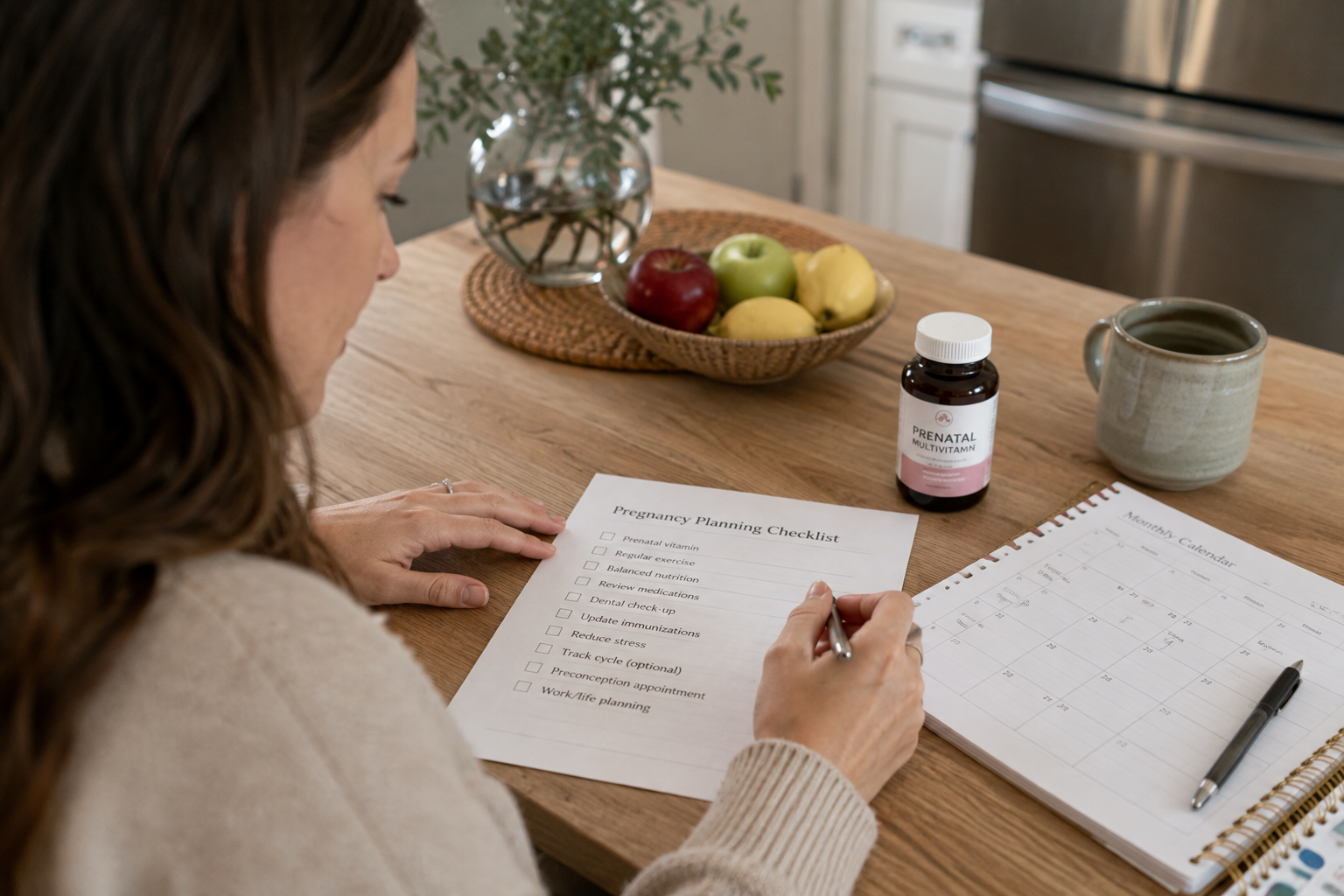
A Practical 30-Day Preconception Checklist
If a long article feels like too much, use this condensed plan.
Start Today
☐ Take a daily prenatal or supplement containing at least 400 mcg of folic acid.
☐ Make a list of every prescription medication, OTC medication, vitamin, and supplement you use.
☐ Schedule a preconception visit if you have medication questions, chronic health conditions, a complicated pregnancy history, fertility risk factors, or simply want individualized counseling.
☐ Check your vaccination record, particularly MMR and varicella immunity.
☐ If you smoke, vape, drink alcohol, or use marijuana or other drugs, make a plan to stop or discuss support with a healthcare professional.
During the Next Two Weeks
☐ Review chronic medical conditions and confirm that your treatment plan is appropriate for pregnancy.
☐ Decide whether you want carrier screening before conception.
☐ Gather relevant family genetic and pregnancy history.
☐ Check whether routine preventive or dental care is overdue.
☐ Identify meaningful workplace or environmental exposures.
☐ Bring caffeine toward less than 200 mg per day if you currently consume substantially more.
☐ Establish a realistic exercise and eating pattern you can continue.
Before Stopping Contraception
☐ Confirm that no medication requires a pregnancy-specific waiting period.
☐ Confirm that you do not need MMR, varicella, or another vaccine that affects conception timing.
☐ If you use an IUD or implant, arrange removal when you are ready to become pregnant.
☐ If you use the birth control shot, discuss its longer return-to-fertility timeline.
☐ Know approximately when your next menstrual cycle begins.
When You Start Trying
☐ Avoid alcohol.
☐ Continue your prenatal vitamin and folic acid every day.
☐ Continue medications exactly as agreed with your healthcare team.
☐ Have intercourse every one to two days during the fertile window if that approach works for you.
☐ Do not assume that failure to conceive in the first month means something is wrong.
What You Probably Do Not Need to Do Before Trying
Preconception preparation can become expensive quickly because the fertility market sells uncertainty particularly well.
For most people without a specific medical indication, you do not need to:
- complete an online “fertility detox”;
- take several fertility supplements at once;
- stop every prescription medicine;
- eliminate entire food groups;
- perform daily ovulation testing for months before trying;
- obtain every fertility hormone test available;
- achieve a particular body weight in four weeks;
- buy a fertility monitor before you understand your normal cycle;
- postpone pregnancy solely because your diet or exercise routine is not perfect.
Do You Need an AMH Test Before Trying?
Usually not as a routine screening test simply because you plan pregnancy.
Anti-Müllerian hormone, or AMH, can provide information about ovarian reserve in certain clinical contexts, particularly fertility evaluation and treatment planning. It is not a simple test of whether someone will or will not conceive naturally.
Current ACOG guidance describes ovarian reserve testing as potentially useful in selected circumstances but an imperfect predictor of reproductive potential.
If your age or medical history creates a reason for early fertility assessment, discuss which tests are actually informative with an ob-gyn or reproductive endocrinologist.
Common Questions About Preparing to Conceive
Is one month enough to prepare for pregnancy?
One month is enough to begin several high-value interventions, including folic acid supplementation, medication review, alcohol avoidance, smoking cessation, and vaccine assessment.
It may not be enough for every situation.
Some medical conditions need longer optimization. Some medications require changes or washout periods. Certain vaccines affect pregnancy timing. DMPA contraception can delay the return of fertility. Higher-dose folic acid may ideally need to begin earlier for people at increased risk of neural tube defects.
Starting now is still useful even if the ideal preparation period would have been longer.
How long should I take prenatal vitamins before trying?
For folic acid specifically, the CDC recommends starting at least one month before conception.
If you begin earlier, that is fine. If you are already trying and have not started, begin now rather than assuming you missed the opportunity.
Should I stop birth control one month before trying?
It depends on the method and whether you would be comfortable becoming pregnant immediately.
Fertility can return quickly after stopping many reversible contraceptive methods, including IUDs, implants, pills, and rings.
You generally do not need to stop several months early to “clear hormones” from your body.
DMPA, the birth control injection, is different because return to fertility can take considerably longer.
Should I get blood tests before trying to conceive?
Not everyone needs the same tests.
Depending on your history, a healthcare professional may recommend testing related to immunity, anemia, diabetes, thyroid disease, sexually transmitted infections, genetic carrier status, or another condition.
Routine broad fertility testing is not necessary for every healthy person before their first cycle of trying.
Should I stop drinking as soon as I start trying?
Yes. CDC guidance recommends avoiding alcohol while trying to get pregnant because exposure can occur before a pregnancy is recognized.
Can I still drink coffee while trying to conceive?
Moderate caffeine consumption is generally compatible with pregnancy. ACOG uses less than 200 mg per day as the moderate range during pregnancy.
You do not need to eliminate caffeine simply because you are trying to conceive.
Do both partners need to take prenatal vitamins?
A prenatal vitamin with folic acid is recommended for the person who may become pregnant.
A reproductive partner does not automatically need a prenatal vitamin. Their nutritional or supplement needs should be based on their own health and diet.
Should I start tracking ovulation before we try?
You can, but you do not have to.
Tracking the first day and approximate length of your menstrual cycles may be enough initially. Once you begin trying, ovulation predictor kits or cervical mucus tracking can help identify fertile days if you want more precision.
How soon can pregnancy happen after stopping birth control?
With many methods, pregnancy can occur quickly, sometimes within the first cycle after stopping.
There is no medical requirement to wait for several natural menstrual periods after discontinuing most reversible contraceptive methods before trying.
The main exception to rapid return of fertility is the contraceptive injection, which can suppress ovulation for longer after the final dose.
If You Only Do Five Things This Month
If the full checklist feels overwhelming, narrow it to these five:
1. Start 400 mcg of folic acid every day.
2. Review medications, supplements, and chronic medical conditions.
3. Check your vaccine history before pregnancy limits your options for live vaccines.
4. Stop smoking and avoid alcohol once you begin trying.
5. Understand your birth control and fertility timeline.
Everything else can be individualized.
Preconception care works best as risk reduction, not as a test you must pass before you are allowed to try for pregnancy.
Once those higher-priority issues are addressed, the next useful step is surprisingly ordinary: continue the habits you can realistically sustain, learn roughly when your fertile days occur, and begin trying without expecting the first cycle to provide an immediate verdict on your fertility.
Editorial medical note: This article provides general educational information and does not replace individualized medical advice. Preconception recommendations can differ based on medications, medical conditions, pregnancy history, age, vaccination status, and fertility history.