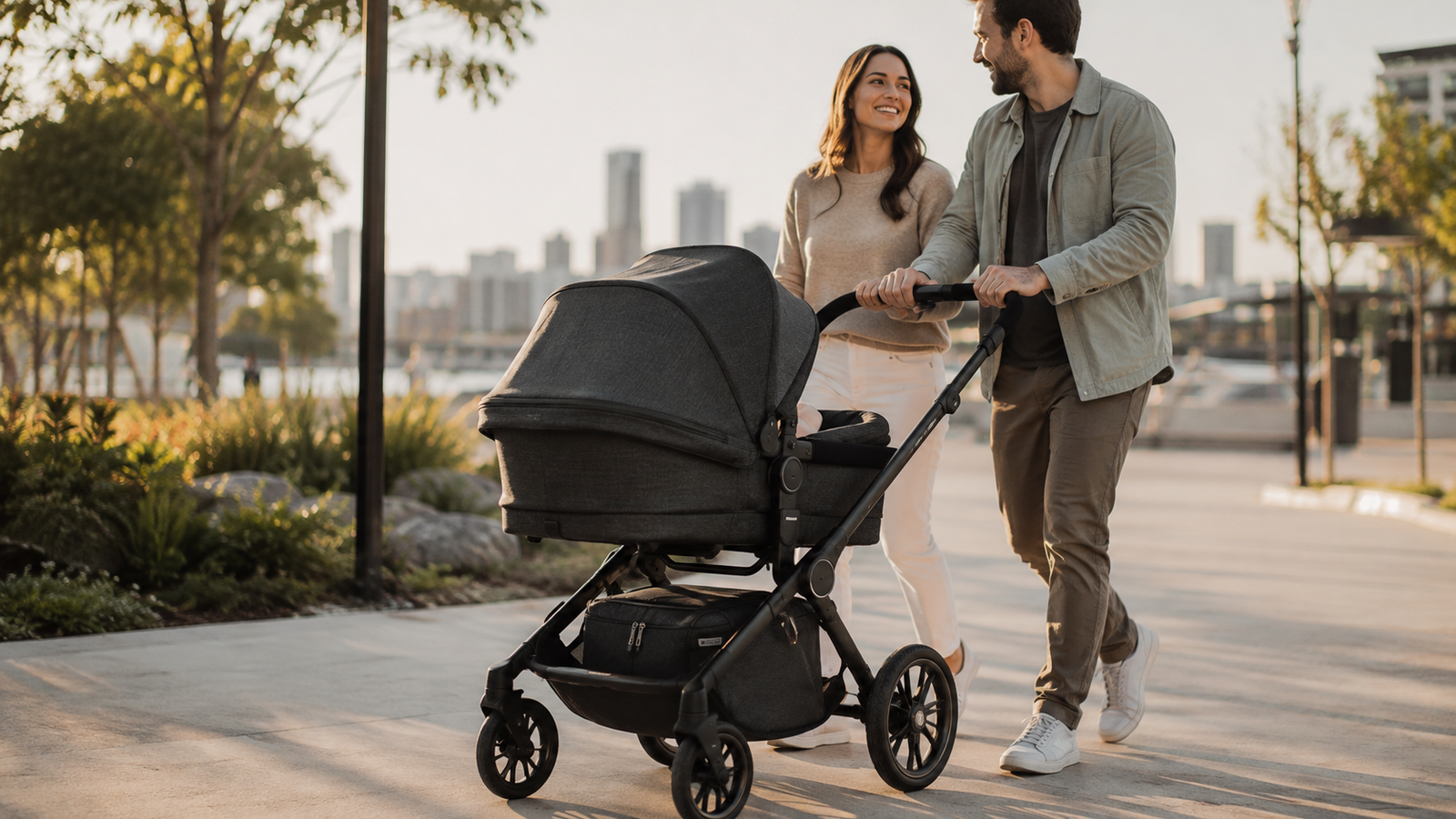
This stroller buying guide recommends selecting a stroller based on your daily lifestyle, living space, and terrain. First, verify newborn readiness (either a flat recline, bassinet, or car seat adapter). Next, evaluate the folded dimensions against your vehicle trunk space and test the one-hand fold mechanism. Finally, ensure the model meets Consumer Product Safety Commission (CPSC) guidelines with a secure five-point harness and dependable single-touch linked brakes.
Purchasing a baby stroller represents one of the largest financial and practical investments for new parents. Because hundreds of models crowd baby gear aisles, finding the right match can quickly feel overwhelming. In addition, what works perfectly for an urban walking family may fail completely for a suburban family relying on daily car travel.
Therefore, using a structured stroller buying guide helps you compare critical mechanical features, avoid costly buying mistakes, and pick a model suited to your daily routine.
How to Match a Stroller to Your Daily Lifestyle
Before comparing cup holders or fabric colors, you must evaluate where and how you will use your stroller most frequently.
Urban and Walkable Neighborhoods
If you walk everywhere and navigate narrow doorways, city sidewalks, or public transit, look for a durable full-size stroller with nimble steering. Because you will carry groceries on foot, an expansive storage basket and puncture-proof foam-filled rubber wheels are essential features.
Suburban and Vehicle-Dependent Living
If you drive to parks, daycares, and grocery stores, your stroller will spend substantial time in your trunk. Therefore, lifting weight and folding convenience matter far more than oversized wheels. A lightweight frame with an effortless one-hand standing fold will save your back during daily errands.
Active Outdoor and Travel Lifestyles
If you run, hike dirt trails, or travel frequently by air, specialized gear is necessary. Traditional everyday strollers cannot safely handle jogging speeds or rough trails. Consequently, active families often purchase a dedicated all-terrain stroller or an ultra-compact travel stroller that fits into airplane overhead bins.
The 5 Main Types of Baby Strollers
Understanding standard stroller categories allows you to narrow your search immediately.
| Stroller Type | Typical Weight | Best For | Main Advantage | Potential Drawback |
| Full-Size Everyday | 20 to 30 lbs | Daily walks, primary family use | Durable, modular, large basket | Heavy, bulky to lift into trunks |
| Lightweight / Travel | 12 to 17 lbs | Errands, road trips, flying | Compact fold, easy to carry | Smaller wheels, less suspension |
| Travel System | 22 to 32 lbs | Newborn stage from day one | Car seat clicks in seamlessly | Bulky once baby outgrows infant seat |
| Double / Convertible | 28 to 38 lbs | Twins or growing families | Expands from single to double | Heavy, wide turning radius |
| Jogging / All-Terrain | 25 to 35 lbs | Running, unpaved trails | Air-filled tires, smooth ride | Long footprint, not newborn-safe for running |
7 Critical Stroller Features to Compare Before Buying
When comparing product specifications online or in showrooms, focus on these seven core mechanical features.
1. Newborn Compatibility and Recline Options
Standard stroller seats cannot support a newborn who lacks head and neck control. According to pediatric safety guidance, babies under six months require a completely flat sleep surface or an approved infant car seat adapter to keep airways open.
Look for strollers with a true flat recline, an optional bassinet attachment, or universal infant car seat adapters. If a stroller seat only reclines halfway, you cannot use it until your baby reaches six months of age.
2. Weight and Folded Dimensions
Do not rely on product marketing photos to judge stroller size. Always check the exact product weight and folded dimensions.
If you must carry the stroller up apartment stairs or lift it into a high SUV trunk, aim for a total weight under 22 pounds. Furthermore, measure your vehicle trunk dimensions to verify that the folded frame leaves room for groceries.
3. One-Hand Fold Mechanism
Parenting frequently requires holding a fussy baby in one arm while folding gear with the other. Therefore, a true one-hand self-standing fold is an invaluable feature.
Test whether the fold mechanism requires multiple complex latches. A stroller that stands upright when folded keeps fabric clean from dirty parking lot pavement.
4. Wheel Material and Suspension System
Wheel quality directly dictates how smoothly the stroller glides over curbs, grass, and uneven asphalt.
- Plastic EVA wheels: Lightweight and inexpensive, but they transfer every sidewalk bump to your infant. Best for smooth mall floors.
- Foam-filled PU rubber wheels: Durable, maintenance-free, and provide excellent shock absorption without ever going flat.
- Pneumatic air-filled tires: Deliver the smoothest glide over rough terrain, but require periodic tire inflation and puncture maintenance.
In addition, look for all-wheel suspension rather than rear-wheel-only springs. Quality suspension protects your baby’s head from constant micro-vibrations during long walks.
5. Five-Point Safety Harness and Buckle Quality
A reliable five-point safety harness secures your child across both shoulders, around the hips, and between the legs. Avoid older three-point lap belts, which allow toddlers to climb or slide out.
Check how easily you can adjust harness height as your baby grows. Magnetic buckles and no-rethread harness straps make daily strapping much faster.
6. Canopy Coverage and Sun Protection
A high-quality canopy should feature UPF 50+ UV protection and extend far enough forward to shade your child during morning and late-afternoon walks.
Look for silent magnetic peek-a-boo windows rather than noisy hook-and-loop Velcro tabs. A mesh ventilation panel provides cooling airflow during hot summer months.
7. Storage Basket Capacity and Weight Limits
Storage baskets vary widely across brands. Some baskets hold only ten pounds and feature narrow openings blocked by frame bars.
In contrast, premium baskets support up to twenty-five or thirty pounds with easy front and rear access. If you commute on foot or carry a large diaper bag, prioritize an accessible, reinforced under-seat basket.
Stroller Safety Standards and Recall Precautions
Safety remains the top priority when selecting infant gear. In the United States, all commercial strollers must comply with federal safety standard ASTM F833, enforced by the Consumer Product Safety Commission (CPSC).
When evaluating any model, verify the following baseline safety elements:
- Single-touch linked parking brakes: One foot pedal should securely lock both rear wheels simultaneously.
- Pinch-point protection: Folding hinges and adjustable joints must have safety guards to prevent catching tiny fingers.
- Stable wheelbase: The stroller must resist tipping backward when you hang lightweight items or when your child leans back.
- No unsafe aftermarket accessories: Avoid attaching heavy shopping bags to the handlebar, which causes sudden tip-overs.
How to Test a Stroller in the Store: The 5-Minute Checklist
If you have access to a retail showroom, perform this practical five-minute evaluation before purchasing:
- The One-Hand Push Test: Push the floor model with a single hand. Walk around tight corners to assess the turning radius.
- The Weight Lift Test: Fold the floor model and lift it waist-high with your non-dominant hand to simulate loading a trunk.
- The Kick-Check: Walk behind the stroller using your normal stride. If your feet constantly kick the rear axle, look for a model with an adjustable telescoping handlebar.
- The Harness Test: Fasten and unfasten the five-point buckle three times to ensure it does not pinch your fingers.
- The Basket Squeeze: Try sliding a fully packed backpack into the storage basket from both the back and front.
Making the Right Stroller Decision
No single stroller is universally perfect for every household. The best choice balances your living space, commuting habits, and family planning goals.
By prioritizing newborn compatibility, wheel suspension, and folding convenience over cosmetic trends, you will choose a durable stroller that supports your family through years of daily adventures.
FREQUENTLY ASKED QUESTIONS
When should I buy a stroller during pregnancy?
Most expectant parents finalize their stroller purchase between weeks 28 and 34 of pregnancy. Ordering during the early third trimester provides sufficient time for shipping, unboxing, assembling, and practicing the fold mechanism before your baby arrives.
Can a newborn baby go in a standard stroller seat?
No, newborn infants cannot ride in an upright or partially reclined stroller seat. Because newborns lack head and neck control, they require a completely flat lie-flat bassinet, a stroller seat with a certified 180-degree flat recline, or an approved infant car seat clicked into compatible frame adapters.
Is a travel system better than buying a stroller and car seat separately?
A travel system offers guaranteed frame compatibility and cost savings in a single bundle. However, buying separately allows you to select a premium lightweight infant car seat paired with your preferred specialized stroller frame, rather than settling for bundled compromises.
How long does a standard stroller typically last?
A well-built full-size stroller typically lasts three to five years, easily accommodating a child from birth up to 45 or 50 pounds. Many high-end modular models can also convert into double strollers when a second child arrives.